
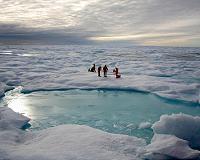
Marine scientists from Germany have been monitoring litter levels in the Arctic since 2002. They say the problem is getting worse.
Litter is identified in photographs taken by their Ocean Floor Observation System, OFOS, which includes 21 underwater observatory stations. Two of the stations and their underwater cameras are dedicated to counting garbage.
Between 2002 and 2014, scientists identified 89 pieces of litter — plastic bags, glass shards, fishing nets — in 7,058 photographs. Researchers used other Arctic garbage studies to extrapolate their findings.
Between 2002 and 2014, researchers determined the Arctic hosted an average of 3,485 pieces of litter per square kilometer, or 1,345 pieces per square mile. In 2011, the average was 4,959 pieces per square kilometer, and in 2014, it was 6,333.
Researchers detailed their calculations in the journal Deep Sea Research I.
"Our time series confirms that litter levels in the Arctic deep sea have risen rapidly in the past few years," Mine Tekman, a biologist at the Alfred Wegener Institute's Helmholtz Centre for Polar and Marine Research, said in a news release.
Scientists say it's difficult to determine the origins of litter seen in the photographs, but they assume much of it is delivered by the Gulf Stream. Some, they now believe, is carried and deposited in the Fram Strait by sea ice. The Fram Strait is an ocean passage between Greenland and Norway's Svalbard archipelago.
"If we're right, sea ice could entrain floating litter during ice formation. During warmer periods, the ice breaks up and is transported to the south into the Fram Strait with the Transpolar Drift, releasing entrained litter into the survey area when it melts," explained deep-sea biologist Melanie Bergmann. "To date we've assumed just the opposite, since we viewed the ice as a barrier to litter contamination."
Scientists say it's also hard to determine whether they're witnessing an uptick in microplastic pollution or evidence of larger plastic pieces fragmenting as they drift to the bottom of the ocean. In 2016, scientists spotted a piece of plastic they had witnessed in 2014. Because ultraviolet light doesn't reach the seafloor, debris breaks down very slowly.
"Running into this same piece of plastic twice with hardly any changes to it is a vivid reminder that the depths of the Arctic are at risk of becoming a depot for plastic litter," Bergmann said. "The well-hidden accumulation of litter on the deep ocean floor could also explain why we still don't know where 99 percent. of the marine plastic litter ends up."
Study: Deep-sea mining causes long-lasting ecological damage
Southampton, England (UPI) Feb 10, 2017 –
Analysis by scientists at the National Oceanography Center in England suggest deep-sea mining operations will have long-lasting ecological consequences.
Researchers reviewed the available scientific literature on small-scale sea-floor disturbances and found clear and measurable impacts to marine ecosystems lasting decades.
As metals become scarce on land, the mining industry has turned its attention to the deep sea floor, where vast expanses of nodules rest. Nodules are potato-sized rocks featuring significant amounts of high-quality metals like copper, manganese and nickel.
No commercial deep-sea mining operations are yet underway, but the International Seabed Authority has issued several exploratory mining licenses to companies from multiple countries.
Scientists have been conducting sea-floor disturbance experiments since the 1970s. The predictive value of a single experiment is limiting, but by surveying a variety of these experiments, scientists at NOC were able to identify broader patterns.
All of the experiments analyzed by NOC researchers were much smaller than an actual mining operation.
These studies will underestimate the impacts of mining," researcher wrote in their paper, published in the journal PLOS ONE. "Many would not even represent one month's work for a full-scale commercial operation, which might last for twenty years."
The longest experiment included in the survey lasted 26 years. Though the disturbed site showed some evidence of recovery, biodiversity and abundance remained diminished.
Because the deep sea floor is still poorly understood by scientists, researchers say environmental officials must be extra vigilant in regulating deep-sea mining operations.
