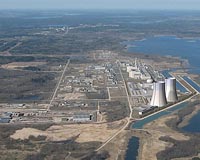
Lithuania formally began the hunt Tuesday for investors to build and run a new nuclear power station in the Baltic state that would replace a crucial Soviet-era plant due to close within weeks.
A tender invitation, open until January 29, 2010, was published by Lithuania in the official journal of the European Union.
It said Vilnius was seeking one or more investors with solid experience in the conception and running of nuclear power plants.
The investor would get a majority stake in the new plant, alongside Lithuania's national power firm and those of Latvia, Estonia and Poland, fellow ex-communist states which are also part of the project.
Earlier this year, Lithuanian authorities singled out seven players who could be in the running: Sweden's Vattenfall, Germany's RWE and E.ON, France's Suez-GDF and EDF, Italy's Enel and Spain's Iberdola.
Other companies Lithuania has said are interested include France's Areva, Spain's Endesa, General Electric-Hitachi and Westinghouse of the United States, Britain's Nukem, Atomic Energy of Canada, and Japan's Mitsubishi Heavy Industries.
Plans for the new plant, which is due to be located at Visaginas in eastern Lithuania, have been in the pipeline for several years. Construction costs are expected to be at least three to five billion euros (4.5 to 7.4 billion dollars).
It will be close to the site of Ignalina, a Soviet-era plant similar in type to the one that exploded at Chernobyl in Ukraine in 1986, the worst-ever nuclear power accident.
Vilnius pledged to close Ignalina by December 31 this year as part of the terms of the ex-communist nation's admission to the EU in May 2004. One of the plant's reactors was shut down in December 2004.
The original target for opening the new plant — expected to have a capacity of to 3,200 megawatts — was 2015. It is now expected to be online by 2018-2020.
Lithuania is worried about a looming power shortfall because Ignalina provides the bulk of its electricity.
There are warnings that power prices could surge next year in Lithuania, which is already in the grip of a deep economic crisis after the end of its "tiger" boom years.
To try to cope, Lithuania plans to link up to the Polish and Swedish electricity grids, which would also enable it to import power from elsewhere in Europe. It has also signed a supply deal with Estonia and held talks with Russia and Belarus.
The Lithuanian nuclear project is one of several in the region.
Poland plans to build its own plant by 2020. Russia aims to construct one by 2016 in its Baltic enclave of Kaliningrad, sandwiched between Poland and Lithuania, and neighbouring Belarus is also planning one by 2016.
Share This Article With Planet Earth