
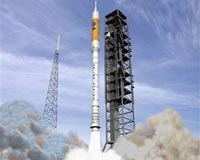
NASA took a tentative first step towards returning astronauts to the Moon on Wednesday with the successful launch of a new generation space rocket.
After several delays, the Ares I-X, the tallest rocket ever built, blasted off at 11:30 am (1530 GMT) from Cape Canaveral in Florida, carrying with it the US space agency's ambitious plans for human space flight.
The rocket is the prototype of the Ares I, designed to carry a new capsule-shaped crew module called the Orion into low-orbit so it can embark on missions to the International Space Station, the Moon, and beyond.
After two and a half minutes, the main part of the 327-foot (100-meter) rocket splashed down as planned in the Atlantic Ocean as applause broke out in a relieved and excited NASA control room.
"It's the most beautiful rocket launch I have ever seen," said NASA program director Jeff Hanley. "I get tears in my eyes. It was very special."
The flight aims to provide engineers with important data for fine-tuning the design of the rocket that with Orion is intended to replace NASA's aging fleet of space shuttles that is due to be retired next year.
Ares and Orion are part of Constellation, NASA's grand program to send astronauts back to the Moon by 2020, and then perhaps to Mars and other destinations.
The shuttle will be retired next year, but the Ares I will not enter into service until 2015 at the earliest. In the interim, NASA will have to rely on Russia to put US astronauts into space, at a hefty price too.
The Orion is initially being designed to take a crew of up to six astronauts on flights to the International Space Station, or four on lunar missions of up to 210 days.
The Orion will be launched by the Ares rocket, but instead of landing back like a plane, as the shuttle does, it will return to Earth with the use of parachutes, more like the Apollo modules that took Neil Armstrong, Michael Collins and Buzz Aldrin to the Moon more than 40 years ago.
Sitting atop the Ares rocket, NASA has included a launch abort system in the design to enable the capsule to jettison out of harm's way should something go wrong.
The test flight comes at a crucial time as the White House is considering a report ordered by President Barack Obama's administration that raises concerns about the the Ares rocket and the whole Constellation project.
The commission, chaired by Norman Augustine, a former executive at aerospace giant Lockheed Martin, concluded that the program "appears to be on an unsustainable trajectory" and was seeking goals not matched by resources.
The Ares rocket has suffered major development problems and its price tag has fueled criticism of NASA, an agency notorious for its cost overruns.
The initial budget for the Constellation program was set at 28 billion dollars, but has swollen to at least 44 billion.
NASA's annual budget is about 18 billion dollars, 10 billion of which is plowed into the human space flight program, chiefly in developing the successor of the space shuttle: the Ares I rocket and the Orion Crew Exploration Vehicle.
The Augustine Commission said an additional three billion dollars a year is needed for NASA to meet Constellation program goals or take human space flight the next step beyond the existing International Space Station.
The commission proposed several alternatives, including sidestepping the rocket and going straight to the Ares V family of launch vehicles, which would take astronauts back to the Moon and eventually on to Mars.
Share This Article With Planet Earth
