
ESA's Euclid mission has passed its critical design review, marking the successful completion of a major phase in the progress of the project. The review verified that the overall mission architecture and detailed design of all its elements is complete, ensuring that it will be able to perform the unprecedented galaxy survey needed to tackle the mysteries of the dark universe, and clearing the way to start assembling the whole spacecraft.
The critical design review (CDR) board meeting took place on 21 November in Noordwijk, the Netherlands. While the individual elements of Euclid – the spacecraft, scientific instruments, launcher, and the operational and science ground segments – had already passed their independent CDRs, the mission-level review focused on the ensemble of all these elements and ascertained their capability to function together to accomplish the mission's goals. The review verified that the most realistic predictions of the combined performances are compliant with the mission requirements.
The review also assessed the feasibility of Euclid's survey with the designed flight hardware, which will image billions of galaxies across the cosmos at unprecedented sharpness and sensitivity during a nominal mission period of six years.
With the completion of this milestone that validated the whole project – from the spacecraft development to launch and operations, including also the observational methods and data analysis strategy – the assembly, integration, and testing of the spacecraft flight model can begin.
Immediately after launch, scheduled for June 2022, the ground segment will be ready to take over and start the operations to perform the groundbreaking sky survey.
Euclid is a medium-class mission in ESA's Cosmic Vision program to investigate the expansion of our universe over the past ten billion years, probing cosmic epochs from before the expansion started to accelerate, all the way to the present. To this aim, Euclid will survey galaxies at a variety of distances from Earth, over an area of the sky covering more than 35% of the celestial sphere.
By making use of both weak gravitational lensing, which measures the distortion of distant galaxies caused by intervening matter, and baryonic acoustic oscillations, based on measurements of the clustering of galaxies, the mission will capture a 3D picture of the evolving distribution of both dark and ordinary (or baryonic) matter in the cosmos.
This will enable scientists to reconstruct the past few billion years of the universe's expansion history, estimating the acceleration caused by the mysterious dark energy to per-cent-level accuracy, and possible variations in the acceleration to 10% accuracy.
The spacecraft consists of a service module – comprising all conventional spacecraft subsystems as well as the instruments' warm electronics units, sunshield and solar arrays – and a payload module.
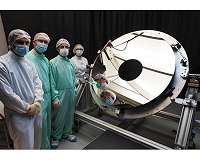
On the payload module, Euclid's telescope – a 1.2-m diameter three-mirror "anastigmatic Korsch" configuration – will direct the cosmic light to two instruments: the wide-field visible imager (VIS) and the near-infrared spectrometer and photometer (NISP).
