
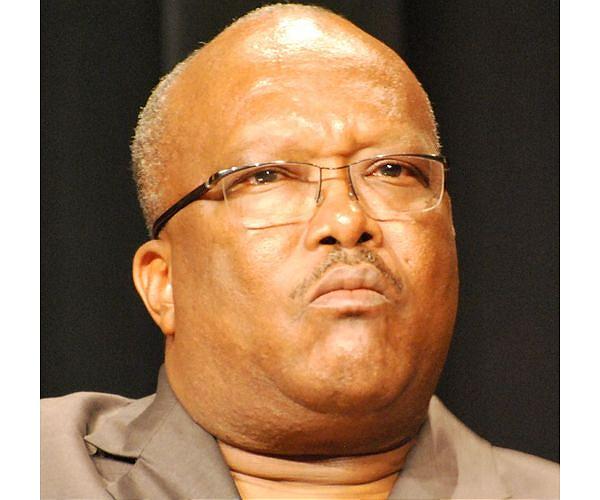
Burkina Faso President Roch Marc Christian Kabore, overthrown in a military coup on Monday, was once seen as embodying hopes for change and development in a West African nation now under siege from jihadists.
The impoverished Sahel state of 21 million people placed its hopes in the affable consensus-building Kabore when voters first elected him in 2015, a year after a popular insurrection toppled strongman Blaise Compaore.
However, it was also in 2015 when armed jihadist groups started to launch attacks in Burkina Faso and have intensified them ever since.
When he was re-elected for a second term in 2020, jihadists were launching attacks virtually daily, and had killed hundreds of people.
The security forces appeared incapable of stopping the violence as whole swathes of the country slipped out of government control.
So Kabore campaigned on the promise that he would make defeating the jihadists his priority.
Casting himself as a father figure promoting national unity, Kabore also promised to foster dialogue and "continuous consultation" over his second five-year term.
Yet the attacks and massacres in the north of the country continue, like those in the village of Solhan in June 2021 when 132 civilians were killed.
In Inata in mid-November, 53 gendarmes and four other people were killed.
Since then, angry demonstrations in jihadist-hit communities have been multiplying to denounce the "impotence" of the authorities — demonstrations that are more often than not crushed by the police.
Kabore, a former banker from the majority ethnic Mossi group and a devout Roman Catholic in a largely Muslim country, made several changes at the head of the army and government but to no avail.
A poorly trained and under-equipped army has failed to overcome the threat.
– 'Armchair' president –
Kabore's People's Movement for Progress (MPP) during his presidency showcased achievements in building roads, improving healthcare and providing access to clean water.
But the ongoing violence, which has forced thousands of schools to close, overshadowed any gains.
Kabore supporters praised his political experience and organisational prowess.
However, pointing to the scale of the unrest, his detractors said he had lost his grip on the country.
A diplomat in neighbouring Ivory Coast once dubbed him "a kind of diffident king who holds plenty of meetings and listens from his armchair without taking decisions".
Opposition figure Fousseny Ouedraogo said Kabore earned the nickname the "diesel president" for his slow pace, pointing to the time he took to appoint a prime minister and reshuffle the cabinet.
– Studied in France –
During Compaore's reign Kabore was appointed minister several times, and he was prime minister from 1994 to 1996.
He led the ruling Congress for Democracy and Progress (CDP) party for more than a decade and was seen as Compaore's likely heir, even joining the group that in 2010 began amending the constitution to keep the strongman in power.
But Kabore abruptly fell out of favour in 2012 and was reduced to a mere "political adviser" — a move that eventually proved to be a blessing in disguise.
Early in 2014, Kabore broke with the CDP to form the MPP, catapulting him to power in a vote widely seen as sealing the transition to democracy.
As a student in the French city of Dijon, Kabore was a committed leftist, and when Burkina's revered Marxist leader Thomas Sankara took power, he became the director of the International Bank of Burkina before he had even turned 30.
When Sankara was gunned down in 1987, Compaore took over the reins. Kabore moved into politics two years later and rose through the ranks, becoming prime minister in 1994 before becoming a special presidential advisor two years later.
Burkina Faso: from popular uprising to military coup
Paris (AFP) Jan 24, 2022 –
As the military takes power in Burkina Faso after soldiers revolt, we look at the troubled West African country plagued by unrest and jihadist violence.
– 2014: Fall of Compaore –
Blaise Compaore takes power in a 1987 coup and cements his position four years later with the first of four election victories. But his 2010 win is contested, as is his attempt to amend the constitution to extend his rule. After being forced from power by street protests in 2014, he takes refuge in Ivory Coast and on November 29, 2015, former prime minister Roch Marc Christian Kabore is elected in his place.
– 2015: Jihadist attacks –
From 2015, the north of the country, the capital Ouagadougou and the east begin to suffer regular kidnappings and attacks by jihadist groups affiliated to the Al-Qaeda or Islamic State groups.
On January 15, 2016, an attack on the Splendid hotel and a restaurant in Ouagadougou leave 30 dead, most of them Westerners, shocking the country.
In November 2017, the French-backed G5 anti-jihadist force starts joint cross-border operations in Mali, Burkina Faso and Niger.
– 2018: Attacks intensify
On March 2, 2018, simultaneous attacks target French forces and the former colonial power's embassy, leaving eight soldiers dead and 85 people injured.
The end of that year sees a state of emergency declared in several provinces.
From 2019, the attacks become almost daily, prompting the sacking of the head of the armed forces and formation of a new government.
On December 24, 42 people die in an attack by 200 jihadists on a military base in Arbinda, near the border with Mali.
– 2020: Kabore re-elected –
Kabore is re-elected on November 22, 2020, but insecurity means hundreds of thousands of people are unable to vote.
The opposition accuse the president of election fraud and refuse to recognise the result.
– 2021: Growing unrest –
Between 132 and 160 people are killed in a June 2021 raid on the northeastern village of Solhan in the worst attack in six years.
The killings spark demonstrations against insecurity and the ministers of defence and security are both fired.
On August 18, an attack in the north leaves 65 civilians and 15 police dead.
In October the president replaces the military chief of staff. A trial also begins into the killing 34 years earlier of charismatic former president Thomas Sankara, the "African Che Guevara". Compaore, the main accused, is not present.
On November 14, at least 57 people, 53 of them gendarmes, are massacred in an assault on a police station at Inata in the north, sparking further protests.
Burkinabe and Niger military say they eliminated around 100 "terrorists" during an operation on their common border between November 25 and December 9.
– New government –
December 8, the prime minister resigns and hands the reins to Lassina Zerbo, who urges national unity.
On December 23, 41 people are killed in yet another jihadist attack in the north.
The past month sees n a further spate of attacks and rumblings of discontent in the ranks of the armed forces echoing those in the wider population.
– 2022: Military takeover –
On Saturday police in Ouagadougou clash with demonstrators at a banned protest over the government's handling of the jihadist threat.
The following day soldiers at several army barracks stage a revolt but the government denies a coup is under way.
On Monday, Kabore is arrested by mutinous soldiers after gunshots are heard near his private residence.
They later announce a military takeover with Kabore's party saying he was the victim of an "aborted assassination attempt".
With his whereabouts still unclear, the United States and European Union call for his release.
