
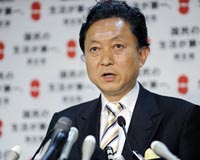
Japan's new prime minister on his first day in office Thursday met labour chiefs to tackle a key challenge for his centre-left government — bringing down the country's highest jobless rate on record.
Yukio Hatoyama met executives of the Japanese Trade Union Confederation, a major support base for his Democratic Party of Japan (DPJ), which has ended half a century of nearly unbroken rule by the pro-business conservatives.
"We believe employment is a top-priority issue," said the government's main spokesman, Chief Cabinet Secretary Hirofumi Hirano, after the new premier met Tsuyoshi Takagi, president of the labour group also called Rengo.
"It's very important to create jobs," said Hirano, a former union official.
Japan's export-led economy, the world's second largest, has stagnated since the early 1990s and was hammered again by the global downturn, which drove unemployment up to 5.7 percent in July, the highest level on record.
Hatoyama, 62, has pledged to create a more "fraternal society," attacked the excesses of US-style capitalism and argued that a society shaped only by market forces will not make people happy.
His cabinet includes former labour chiefs and vocal opponents of the free-market reforms of former prime minister Junichiro Koizumi, which many have blamed for widening the wealth gap and eroding a sense of social security.
Takagi, whose trade union umbrella organisation groups 6.8 million workers, voiced concern about the DPJ's ambitions greenhouse gas reduction goal, which he said may destroy jobs.
The DPJ has pledged Japan would seek to cut emissions by 25 percent from 1990 levels by 2020 — far deeper than the eight-percent pledged by the previous Liberal Democratic Party (LDP) government.
The trade union officials voiced concern that the DPJ's pledge could hamper Japan's industrial competitiveness and dampen employment, said Hirano.
Japan's industrial lobbies have voiced similar fears.
Hatoyama sought the labour group's understanding, saying people also need to safeguard the environment, Hirano said.
"Japan should make a contribution by providing the world with cutting-edge technology," Hatoyama told the union officials, according to Hirano, apparently referring to renewable energy and other "green" technologies.
At a press conference late Wednesday, new Trade Minister Masayuki Naoshima told reporters that because of the climate change target, "it is possible that costs (for households and industries) will increase."
"I know there are opinions from the business community and labour unions and I'd like to proceed with talks with them to gain their understanding," he said.
He added that the pledge "is based on the premise that major emitters such as the United States, China and India participate in the framework."
He also said the target included emission cuts Japan could achieve through international carbon trading and by carbon absorption through forestation.
New Environment Minister Sakihito Ozawa said the DPJ planned to stick to its promised goal of starting a domestic carbon market — in which companies must pay for and can trade rights to pollute — by fiscal 2011.
The DPJ has won international praise for its climate target, but environmental groups have questioned its pledge to also cut highway tolls and petrol taxes, which would likely increase car traffic and emissions.
Share This Article With Planet Earth
