
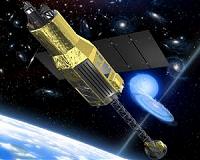
Japan will launch an X-ray astronomy satellite atop an H-2A carrier rocket in February next year, as an effort to elucidate the structure of space and its evolution.
Mitsubishi Heavy Industries, Ltd. and the Japan Aerospace Exploration Agency (JAXA) announced Friday that they decided to launch the H-2A Launch Vehicle No.30 (H-2A F30) with the X-ray astronomy satellite "ASTRO-H" onboard on Feb.12, 2016 from Yoshinobu Launch Complex at the Tanegashima Space Center in Japan's southwestern Kagoshima prefecture.
"Launch time will be set for each launch day if the launch is delayed," said JAXA in a release. The launch window will be between Feb.13-29, 2016.
"To capitalize on the excess launch capability of the H-2A F30, we will also provide launch and orbit injection opportunities for small secondary payloads (piggyback payloads)," said the Japanese space agency.
The ASTRO-H is an astronomy satellite to elucidate the structure of space and its evolution through studying high-temperature and high-energy celestial bodies, such as black holes, supernova remnants, and galaxy clusters by X-rays and gamma-rays.
X-rays and gamma-rays from space are absorbed in the Earth's atmosphere, thus they cannot be observed on the Earth. Therefore observation in space is necessary.
The 14-meter-long ASTRO-H is the 6th Japanese-led X-ray observatory, and the successor to the Suzaku satellite which is currently in space.
Earlier Report
Japanese space probe goes into orbit around Venus
Tokyo, Japan (AFP) Dec 09 – Japan's space agency said Wednesday its "Akatsuki" probe had successfully entered into orbit around Venus after an initial attempt at reaching the second planet from the sun failed five years ago.
The success marks the first time a Japanese space probe has entered into the orbit of another planet, according to Japan Aerospace Exploration Agency (JAXA).
"The probe is functioning properly," Japan Aerospace Exploration Agency (JAXA) project manager Masato Nakamura said during a press conference.
"We'll conduct an inital observation for three months… We'll then shift to full observation in April," he said.
Akatsuki, meaning dawn, blasted off in 2010 on a 25.2 billion yen ($205 million at current exchange rates) mission to observe the toxic atmosphere and super-hot volcanic surface of Venus.
But the box-shaped probe failed to enter the planet's gravitational pull and shot past it, forcing JAXA technicians to make the second attempt.
The successful Venus orbit came a week after another Japanese space probe, "Hayabusa 2", passed by Earth to harness the planet's gravitational pull to propel it toward a far away asteroid in its quest to study the origin of the solar system.
The explorer conducted an "Earth swing-by" and came as close as 3,090 kilometres (1,900 miles) above the planet's surface, before switching its orbit to continue towards the tiny Ryugu asteroid.
Hayabusa 2 was launched a year ago on a six-year mission to bring back mineral samples from the asteroid.
It is expected to reach Ryugu, named after a mythical castle in a Japanese folk tale, in mid-2018.
If all goes well, soil samples will be returned to Earth in late 2020.
Analysing the extra-terrestrial materials could help shed light on the birth of the solar system 4.6 billion years ago and offer clues about what gave rise to life on Earth, scientists have said.
