
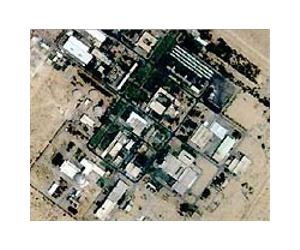
Israel will keep up its longstanding policy of deliberate ambiguity over its nuclear programme, Defence Minister Ehud Barak said on Tuesday, adding that US support for the position remains unchanged.
"This is a good policy and there is no reason to change it. There is complete agreement with the United States on this question," Barak told army radio.
He also said "there is no risk" that inspectors of the International Atomic Energy Agency (IAEA) would get authorisation to inspect Israel's Dimona nuclear reactor.
"There is no threat over the traditional agreements between Israel and the United States on this issue," said Barak.
"I met President Barack Obama and other US officials two weeks ago. All of them told me denuclearisation efforts target Iran and North Korea."
Israel has maintained its so-called policy of deliberate ambiguity about its nuclear programme since the Jewish state inaugurated the Dimona reactor in the southern Negev desert in 1965.
Media reports have said the United States agreed in 1969 that as long as Israel did not test a nuclear weapon or publicly confirm that it had one, Washington would not press it on the issue.
Foreign military experts believe Israel has an arsenal of several hundred nuclear weapons.
Like nuclear-armed countries India, Pakistan and North Korea, Israel has not signed the Nuclear Non-Proliferation Treaty in order to avoid inspections by the Vienna-based IAEA.
But an Israeli scientist on Monday said Israel should end its decades-long silence over its reported nuclear weapons capability and open its nuclear reactor to inspection.
Uzi Even, a Tel Aviv University chemistry professor and former worker at the Dimona reactor, said Obama's campaign for global nuclear arms reduction is a sign of changing times and Israel must get in step.
Also on Monday, however, Strategic Affairs Minister Dan Meridor dismissed as unimportant reports that Egypt had tabled a motion on Israel's nuclear weapons status for a June meeting of the IAEA.
"From time to time this issue is raised at the IAEA and other places," he said. It's not the first time it's mentioned and it's not the first time we'll find a way, with the rest of the world, to deal with it."
earlier related report
Russia hails sending nuclear energy pact to US Congress
Moscow (AFP) May 11, 2010 –
The Russian foreign ministry on Tuesday called President Barack Obama's decision to resubmit a US-Russia nuclear energy cooperation pact to Congress for review a long-awaited positive step.
The agreement, which would allow US and Russian companies to form joint ventures in the nuclear sector and allow exchanges of nuclear technology, was pulled from consideration after relations worsened because of Moscow's brief war with Georgia in 2008.
"We have been waiting for that (pact) for a long time. It is a step in the right direction," foreign affairs spokesman Igor Liakin-Frolov said, according to the ITAR-TASS news agency.
Obama's move was the latest step in his efforts to "reset" ties with Moscow, which have seen the agreement of a replacement for the Strategic Arms Reduction Treaty and the two sides working together on the Iranian nuclear crisis.
The deal's prospects in Congress are not clear, however, with some of Obama's Republican foes feeling that the administration is making too many diplomatic and political concessions to Moscow.
The pact is not a treaty so does not require approval, but must be sent to Congress for a 90-day review period, during which lawmakers can vote to kill it off if they disagree with it.
Share This Article With Planet Earth
