
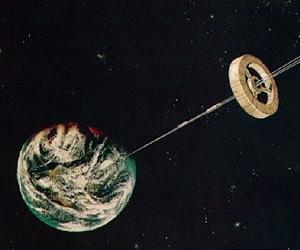
Anyone who follows new space concepts has heard of the Space Elevator. This is conceived as a non-rocket space structure that is intended to transport material from the Earth's surface into space.
The literature is filled with variations on the basic idea, but all involve travelling vertically along a fixed structure as opposed to being launched on a rocket.
This structure could be a cable reaching from a point near the Earth's equator upward to the geostationary orbit, a distance of 35,786 km.
This cable could be held in tension with the help of a counterweight located well beyond the geostationary altitude, or it might be a self-supporting structure.
The concept goes back to 1895 when Konstantin Tsiolkovsky, a Russian school teacher, proposed a free-standing "Tsiolkovsky Tower" that would reach geostationary altitude. With such a tower, a satellite could be carried to the top and released to become a geostationary satellite.
This seems cost effective when compared to using an expensive launch vehicle. However, there are a few challenges that may get in the way of developing an elevator.
First, there is the problem of building such a tower of this height or tension-cable of this length.
We have no proven materials that could withstand the stresses or support the weight, although carbon nanotube technology shows great promise. Fabrication, assembly and operational costs would be very high.
Then, there is the roughly 23,000 orbiting satellites and debris of at least 10 cm in size. Since all orbits cross the equator, and the elevator is in the equator, over a period of time any and all 23,000 objects could collide with the elevator.
Every object would have a relative speed ranging from near zero to over 7 km/sec. Avoidance maneuvers by the elevator have been suggested, but we cannot track all of these objects accurately enough to predict collisions.
I would not call this idea "pie in the sky," but maybe an "elevator too far."
