
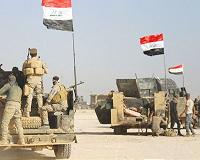
It's their city, their battle, their honour. Iraq's elite "Mosul Regiment" was the last out when the jihadists overran the city, and now wants to be the first back in.
They have moved to within a few hundred metres (yards) of Mosul, two weeks into a huge offensive to take back the city the Islamic State group seized two years ago.
"June 10, 2014, at exactly 10:00 am." The moment stayed etched in Lieutenant Colonel Muntadhar Salem's mind, and righting that wrong has been an obsession of his ever since.
He came within striking distance of his dream on Monday when he and the fighters of the Mosul Regiment started flushing out jihadists from the last two villages before the city's eastern entrance.
The men, from Iraq's elite Counter-Terrorism Service (CTS), set off at dawn from Bartalla, a town they retook last week.
They were soon targeted with mortar fire by IS fighters in a nearby industrial area.
Salem did not blink as two rounds fell on either side of the building where he was posted and a third shaved it before ploughing into the ground farther away.
But one of his medics was hit, and the officer ran to the unfinished building where the wounded soldier was taken with shrapnel in his chest.
The medic was promptly evacuated and the Mosul Regiment continued its advance.
– 2014 debacle –
Salem relentlessly called in coordinates to the US-led coalition, occasionally resulting in air strikes that sent huge mushrooms of dust into the sky.
Colonel Mustafa al-Obeidi's voice came sputtering over the radio as his men advanced cautiously through the village of Bazwaya, sidling along walls and scanning the empty streets with their rifles raised: "They're fleeing, the jihadists are fleeing into Mosul."
The eastern side of Mosul, the city that is the jihadists' last major stronghold in Iraq and where their leader Abu Bakr al-Baghdadi proclaimed his "caliphate" two years ago, is expected to offer limited resistance.
Military sources and residents have for days reported that IS leaders were moving across to the west bank of the Tigris River that runs through Mosul.
Other forces — including soldiers, police and Kurdish peshmerga fighters — are advancing on other fronts, but have yet to approach the city limits.
When the jihadists seized the city in June 2014, the Mosul Regiment was forced to vacate its Al-Ghuzlani base.
"It was the prime minister, Nuri al-Maliki at the time," Salem recalled. "We were ready to stay."
But there were only a few hundred of them and the rest of the security forces stationed in Mosul had fled, abandoning vehicles and other equipment, and sometimes their uniforms.
The leadership in Baghdad argued that "it was not worth sacrificing our men, the best-trained fighters, for such an unevenly matched battle", said another CTS colonel who gave his name as Murtada.
Since then, the CTS has spearheaded the fightback, retaking one city after another.
– Sky-high morale –
Murtada's eyes were shining when he mentioned his former base, now just a short push away.
"This is where we lived, where we did our job," he said.
All members of the Mosul Regiment fondly remembered what they described as a sense of brotherhood devoid of any sectarian feelings on Al-Ghuzlani base.
Murtada, a native of Karbala, a holy Shiite city south of Baghdad, became emotional when he spoke of his Sunni friend Ahmed, who was killed in action.
"The counter-terrorism forces are the last bastion sectarianism hasn't broken into," Salem said.
Yet they already know that destruction is all they will find when they return to the base.
"We used to have a sports field, a shooting range, a prison, a helipad, our barracks," Salem said, pointing to each facility on an old satellite picture of the area.
With a swipe of his tablet, he brought up a image taken by the US-led coalition recently: there was nothing left — just a desolate expanse of sand and rubble.
"The jihadists used bulldozers: they levelled everything," said Murtada.
But two years of a gruelling campaign against IS, a group whose suicidal but effective fighting tactics once left the world struck with awe and fear, have earned the CTS a reputation of its own.
Now, with the streets of Mosul almost within reach, morale was sky-high among the men of the Mosul Regiment.
As he clutched his rifle, Salem pledged that his regiment's homecoming was close, and so was the demise of the group "that wrecked the image of Islam across the world".
The battle for Mosul: What we know
Baghdad (AFP) Oct 31, 2016 –
Iraq launched an offensive to retake Mosul from the Islamic State group two weeks ago. Here is what we know so far about the country's biggest military operation in years:
Which Iraqi forces are involved?
Iraq's Counter-Terrorism Service and Rapid Response Division — two of its most elite special forces units, are fighting in the Mosul area, as are the army, federal and local police, Kurdish regional peshmerga and pro-government paramilitary forces.
The Hashed al-Shaabi — an umbrella organisation for pro-government paramilitary forces that is dominated by Iran-backed Shiite militias but also includes Sunni tribesmen — largely remained on the sidelines in the early days of the operation, but has now also entered the fight.
Where are they attacking?
The Mosul operation opened with attacks from the north, east and south, but ground forces have yet to deploy on the western approach to the city — which is exposed to IS-held areas between it and Syria.
The Hashed al-Shaabi wants to change that, aiming to retake the town of Tal Afar west of Mosul and cut jihadist supply lines to Syria, but they are still fighting in areas south or southwest of the city for now.
How are the jihadists responding?
With brutality, as they have often done before.
The United Nations said it has received credible reports that IS executed more than 250 people in the Mosul area over two days last week, and has also seized tens of thousands of people for use as human shields.
The jihadists have repeatedly targeted attacking Iraqi troops with suicide car bombs, as well as employed artillery and small arms fire.
Outside of the Mosul area, IS has launched several diversionary attacks, including one in the Kurdish-held city of Kirkuk that left dozens dead. The jihadists also struck in Rutba in western Iraq, and the Sinjar area in the country's north.
There have been conflicting reports of IS movements during the battle, pointing to both withdrawals to neighbouring Syria and the deployment of reinforcements to Iraq.
The United States says the battle has taken a heavy toll on IS forces, with up to 900 killed in the first week and a half of the operation.
How are civilians affected?
As Iraqi forces approach, thousands of civilians have been fleeing IS-held areas to escape both jihadist rule and impending fighting.
The International Organization for Migration said Monday that 18,258 people have been displaced since the beginning of the operation, but that figure is expected to increase dramatically as Iraqi forces close in on Mosul.
According to the UN, up to one million people could be displaced by the battle for the city — a major problem given that existing, under-construction and planned camps can only house about half that number.
Displacement is especially difficult for rural farming communities, whose wealth lies in fields and livestock that they cannot take to camps.
The situation for displaced Iraqis will get even more difficult as winter rains and colder weather set in.
