
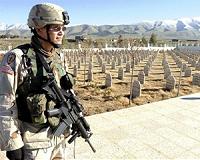
Hundreds of Kurds gathered in the Iraqi town of Halabja on Saturday in a tearful ceremony commemorating Saddam Hussein's poison gas attack there which killed some 5,000 people, mostly women and children.
On March 16, 1988, Saddam's forces unleashed a cocktail of deadly gases on the northern farming community, captured a day before by Kurdish fighters who had sided with nearby Iran in the countries' eight-year war.
Facing a barrage of Iraqi regime artillery and air strikes, Kurdish forces and most of the town's men had withdrawn to the surrounding hills, leaving behind women, children and the elderly.
The following day, Iraqi fighter planes circled above the area for five hours, releasing toxic gases including sarin and mustard gas.
Marking 31 years since the massacre, tearful relatives on Saturday carried portraits of the victims in a solemn ceremony of remembrance.
Halabja Governor Azad Tawfiq called for compensation and care for survivors still suffering from respiratory problems.
"The Kurdish government, the Iraqi central authorities and the international community owe a debt to Halabja," he said.
Iraq's President Barham Saleh, himself Kurdish, said that "the sufferings of Halabja reflect those of the Kurds and all Iraqis."
Writing on Twitter, he said the town embodied "the will to resist and be reborn" in a country ravage by decades of conflict, most recently the battle against the Islamic State jihadist group.
Prime Minister Adel Abdel Mahdi said the Halabja attack was an act of "genocide" and "barbarity".
The Halabja victims were among some 180,000 people killed during the regime's "Anfal campaign" against the Kurds.
Ali Hassan al-Majid, a cousin of Saddam better known as "Chemical Ali", was hanged in 2010 for ordering the 1988 attack.
Saddam himself was hanged in 2006 after being found guilty over the deaths of 148 Shiite villagers.
Iraq opens first IS mass grave in Yazidi region
Kojo, Iraq (AFP) March 15, 2019 – Iraqi authorities on Friday opened a first mass grave containing victims of the Islamic State group in the Yazidi stronghold of Sinjar, where jihadists brutally targeted the minority.
Nobel Peace Prize winner Nadia Murad, a Yazidi who escaped IS and became an outspoken advocate for her community, attended the ceremony in her home village of Kojo to mark the start of exhumations.
The United Nations, which is assisting with the forensic work, says the first opening of a mass grave in the region will help to shed light on the fate those inhabitants killed by IS.
Hundreds of men and women from the village are believed to have been executed by the jihadists when they took over the area in 2014.
The Yazidi people were targeted by the IS jihadists who swept across northern Iraq in 2014 and seized their bastion of Sinjar near the border with Syria.
IS fighters slaughtered thousands of Yazidi men and boys, then abducted women and girls to be abused as sex slaves.
The Kurdish-speaking Yazidis follow an ancient religion rooted in Zoroastrianism, but IS considers them to be "apostates".
The United Nations has said IS's actions could amount to genocide, and is investigating the jihadist group's atrocities across Iraq.
Murad called at Friday's event for Iraq's central authorities and those in the Kurdistan region to "protect the mass graves" so that proof could be found of the "genocide of the Yazidis".
"There will not be reconciliation with the Arab tribes of our region if their dignitaries don't give the names of those who carried out the crimes so they can be judged," she said.
The head of the UN investigative team Karim Khan said the exhumation marked an "important moment" for the probe, with 73 mass graves discovered so far in Sinjar alone.
"The road towards accountability is a long one, and many challenges lay ahead," he said in a statement.
"Notwithstanding this, the spirit of cooperation between the survivor community and the government of Iraq is to be applauded."
IS is currently battling to defend the last shred of its crumbling "caliphate" across the border Syria in the face of Kurdish-led forces backed by an international coalition.
