
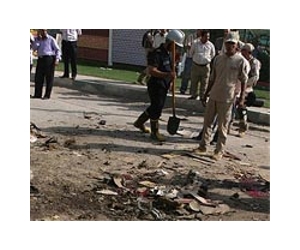
Twenty-seven people were killed and more than 100 wounded in a string of attacks across Iraq on Thursday ahead of Christmas and the Shiite commemoration ceremonies of Ashura.
In the worst attack, 15 people including a provincial councillor were killed and 70 wounded when twin bombs struck outside a busy bus station in Hilla, south of Baghdad, Iraqi officials said.
"Fifteen people, including provincial councillor Neemat al-Bakri, were killed and 70 wounded in the explosion caused by a car bomb and a mine," said an interior ministry source.
Bakri was a member of the multi-confessional alliance formed by Prime Minister Nuri al-Maliki to contest parliamentary elections scheduled for March next year.
Also identified among those killed was Colonel Taleb al-Shamri, a police officer in charge of local efforts to eradicate improvised explosive devices.
The attack took place in a car park in the centre of Hilla, a mainly Shiite town that is the capital of Babil province.
Witness Fadel Hassa, 25, who has a shop nearby, said a car had stopped at the Babel Hussein bus station around 1:30 pm (1030 GMT) and that the explosion occurred within moments.
"A few minutes later… police came to disarm a bomb placed some 20 metres (yards) from the site of the first attack, and it exploded as they arrived, causing numerous injuries among passersby and the police."
In the sacred Shiite town of Karbala, 110 kilometres (70 miles) south of Baghdad where pilgrims were converging for Ashura ceremonies culminating on Sunday, a bomb killed one person and wounded 12, security sources said.
The late afternoon attack occurred despite the deployment of 20,000 police.
In Baghdad, eight people were killed and 30 others injured when two explosive devices went off earlier in the afternoon.
The first bomb was attached to a car near a commemoration ceremony in Sadr city, the poor Shiite neighbourhood north of the capital, leaving five dead and 25 wounded, according to a military spokesman.
The second, which killed three people and injured 20, exploded in Zafraniya, south of the city centre, where a preliminary Ashura ceremony was also taking place.
Ashura, which means tenth in Arabic, falls on the tenth day of the Muslim month of Muharram and commemorates the death of Hussein, a grandson of the Prophet Mohammed.
Tradition holds that Hussein was decapitated and his body mutilated by the armies of Sunni caliph Yazid in 680 AD.
In Mosul, 350 kilometres (220 miles) north of Baghdad, a 23-year-old Christian, Bassel Icho Yuhanna, was killed when gunmen opened fire on his minibus as he was parking it in front of his house in the east of the city, police chief Mohammed Jassem said.
In Kirkuk, 240 kilometres (150 miles) north of Baghdad, local army captain Zamel Mohammed was killed in a bomb attack on his car as he was driving through the north of the city.
In Sharkat, 290 kilometres (180 miles) north of Baghdad, a member of the Sahwa anti Al-Qaeda militia group was killed and three of his comrades wounded when gunmen opened fire on their checkpoint.
The Sahwa, known as the "Sons of Iraq" by the US army, joined American and Iraqi forces to wage war in 2006 and 2007 against Al-Qaeda and its supporters, leading to a dramatic fall in violence across the country. But attacks remain common in some areas.
earlier related report
Iraq Christians mark Christmas under threat
Mosul, Iraq (AFP) Dec 24, 2009 –
Iraq's dwindling Christian population has little to celebrate this Christmas after a spate of attacks against their community including on Thursday killed several and put the army on alert.
In the main northern city of Mosul, where the Christian minority has long been concentrated, churches have been bombed, Christians gunned down and the community is fearful.
The latest victim was a Christian minibus driver who was killed Thursday in east Mosul by unknown gunmen, police said. It was the seventh attack targeting Christians in the city in the past month.
"This was all a dream we used to live in for many years, and then the nightmare came back and a black cloud came over us," said Jamil Butrus, a 59-year-old Christian lawyer.
"Our joy and parties turned to hell — killing, threats and explosions. You do not know what the aim of it is or who is doing it."
The Iraqi army has been put on alert in areas with large Christian populations such as Mosul and the surrounding province of Nineveh, the ethnically mixed province of Kirkuk, and in Baghdad.
Troops have been out in force in Mosul since celebrations marking the Islamic new year last week, and roads leading to churches have been closed off.
All of the city's churches are now guarded by checkpoints and military patrols.
"Today, the streets that lead to churches look like a military base — they are blocked by barbed wire and concrete barriers with policemen all around," said 56-year-old engineer Younis Mekha, a Christian.
"You have to park your car far away and then walk. Policemen or soldiers will give you a scary look and ask you where you are going, tell you to go back, that you are not allowed to go in.
"You tell him: 'Yes, I know, but I am a Christian and I have come to pray.' Then you give him your ID papers and after checking them, he lets you in."
However the tight security measures have failed to prevent violence.
A bomb attack against a historic church in Mosul on Wednesday killed two people — both of them Muslims — and wounded five.
A handcart was left across the street from the Syrian Orthodox Church of St Thomas where it exploded.
"This church was visited by Muslims as well as Christians, to see the statues, the decorations, the inscriptions on its walls, and to know its history," said 39-year-old Rafa Abdul Noor, a deacon at the church which was founded in 770 AD and partially restored in 1744.
"Now it is being targeted by cowards. Their aim is to stop the celebration of Christmas, to stop prayers to stop the mention of God's name in his houses, and to push sectarianism among the people of the country."
Last year, thousands of Christians fled Mosul in the face of violence that killed 40 members of the community.
Since the US-led invasion of 2003, hundreds of Iraqi Christians have been killed and several churches attacked.
Around 800,000 Christians lived in Iraq at the time of the invasion, but their number has since shrunk by a third or more as members of the community have fled abroad, according to Christian leaders.
"Before 2003, Christians used to live a happy and secure life — I can't remember a Christian being killed, threatened or displaced," said 62-year-old Zakariyah Yahya Abi Salman, a retired teacher.
"Only God knows what happened to this city."
Share This Article With Planet Earth
