
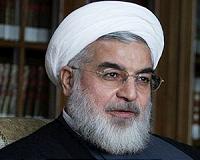
Iranian President Hassan Rouhani on Wednesday called for unity in the face of the country's "enemies", at a tense religious ceremony during which he was repeatedly interrupted.
"We need unity and cohesion," Rouhani said, citing Islamic republic founder Ayatollah Ruhollah Khomeini, who died on June 4, 1989, at a ceremony on the eve of the anniversary.
"The enemies want to create discord among ethnic groups and religions… The first step is to be united," he said.
Iran and the P5 + 1 — the United States, Russia, China, France, UK and Germany — have been negotiating since 2013 on limiting the nuclear ambitions of Tehran, suspected of trying to acquire the atomic bomb, in exchange for lifting international sanctions imposed since 2006.
Both parties have given themselves until June 30 to prepare a full and final text.
Rouhani's speech at the Imam Khomeini mausoleum in southern Tehran was interrupted several times by the crowd chanting pro-Khomeini slogans and for his successor, supreme leader Ayatollah Ali Khamenei.
Iranian and US negotiators are under intense pressure from conservatives in Iran.
The country's negotiating team, led by Foreign Minister Mohammad Javad Zarif, is accused of having made too many concessions to the West in the talks.
Khamenei, while supporting the Iranian negotiators, has often expressed his doubts about the possible outcome of the negotiations.
Iran nuclear talks resume in Vienna
Washington (AFP) June 3, 2015 –
Top US officials gathered Wednesday in Vienna to resume nuclear talks with Iran as the Austrian capital hunkered down to host the negotiations ahead of a June 30 deadline.
Under Secretary of State Wendy Sherman will lead America's delegation to a new round of talks Thursday with global powers in the Austrian capital, US officials said.
She was meeting with her counterparts from the P5+1 group on Wednesday, before Thursday's talks with the Iranian team led by senior Iranian negotiator Abbas Araghchi.
It had not yet been determined how long Sherman would stay in Vienna, a State Department spokeswoman Marie Harf said.
"We will be sending people out to Vienna, as needed," Harf said. "But I expect this will be where the action is on these talks for between now and June 30."
The new talks open amid uncertainty over whether US Secretary of State John Kerry, who has been deeply engaged in the nuclear issue over the past 18 months, will be able to travel to Vienna after breaking his leg in a cycling accident.
Sunday's fall in the French Alps came a day after Kerry spent six hours locked in bilateral talks with his Iranian counterpart Mohammad Javad Zarif in Geneva.
– Kerry recovering from surgery –
He was recovering in hospital Wednesday from surgery to mend his right femur.
"Yesterday the secretary was up and out of bed. He had a good night. Was up early today. And started physical therapy," Harf said.
Kerry's doctor has said he wanted to get the globe-trotting diplomat walking again on Wednesday, and insisted Kerry's recovery would not interfere with his duties as secretary of state.
But details of the top US diplomat's condition remain sparse. Harf refused to divulge whether Kerry had been fitted with a cast, and what his rehabilitation program would be.
State Department officials have insisted he plans to join the Iran negotiations for the final phase around June 30.
Six global powers — Britain, China, France, Germany, Russia and the United States — are trying to nail down a deal to curb Iran's nuclear ambitions by reducing its stockpiles of enriched uranium and mothballing some of its sites.
Harf on Wednesday hit back at a New York Times story about a UN report alleging Iran's uranium stockpile had grown 20 percent during the past 18 months.
She took issue with accusations by the US daily that US experts could not "figure out why" the stockpile was growing when Iran has promised to freeze its enrichment program.
"That's just not the case," Harf told reporters. "This type of stockpile … can go up and down. That's perfectly acceptable."
She stressed the most important issue was that Iran had pledged to reduce its stockpile from seven tonnes to 300 kilograms. The fact that the stockpile has grown "is allowable" under the terms of a 2013 interim deal "as long as they get back where they need to be."
