
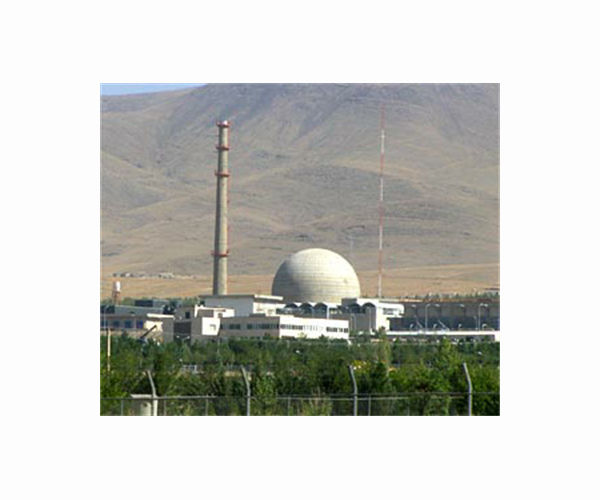
An Iranian nuclear reactor being converted from heavy water production into a power generating research facility will be launched within a year, a spokesman for parliament's energy commission announced.
Under a 2015 nuclear deal between Iran and world powers, the Islamic republic shut down the original Arak reactor in Markazi province so that it could not produce military-grade plutonium.
It also pledged that a replacement of the original reactor with a new one would support "peaceful nuclear research".
Quoted on Sunday by the Fars news agency, Mustafa Nakhai, spokesman of the legislature's energy commission, said "the Arak IR-20 reactor will be launched in a year from now".
Nakhai said he was in turn quoting Mohamed Eslami, newly-appointed to head the Iranian Atomic Energy Organisation (AEOI).
He also quoted Eslami as saying the new IR-20 reactor at Arak will feed into the generation of a planned 8,000 MW of nuclear power, to be achieved by the construction of additional reactors, state news agency IRNA reported.
Nuclear chief Eslami also said in mid-September during a site visit to Arak that Iran wanted to establish the long-planned research facility "as quickly as possible".
The AEOI had said early this year that it would cold test the new reactor in the first three months of the Iranian year, which began on March 21.
The 2015 nuclear deal gave Iran sanctions relief in return for tight controls on its nuclear programme, monitored by the UN.
Tehran has gradually rolled back its nuclear commitments since 2019, a year after then US president Donald Trump withdrew from the multilateral deal and began reimposing sanctions.
Talks began in April in Vienna in a bid to bring the US back inside the deal, but the dialogue has been stalled since June, when ultraconservative Ebrahim Raisi was elected as Iran's president.
Iran says foresees nuclear talks resuming by early November
Tehran (AFP) Oct 4, 2021 –
Iran foresees talks with world powers aimed at reviving its nuclear deal resuming by early November, foreign ministry spokesman Saeed Khatibzadeh said Monday.
"I don't think it will take us the same amount of time as it took the Biden administration to come," Khatibzadeh said, referring to US diplomats under President Joe Biden indirectly joining the Vienna talks.
For the government of Iran's ultraconservative new President Ebrahim Raisi, "I don't think the (return to talks) will take as much as 90 days," he said, suggesting talks will be underway again by early November.
It is the first time Iran has suggested a rough date for a possible return to the table.
The 2015 nuclear deal gave Iran sanctions relief in return for tight controls on its nuclear programme, monitored by the UN.
In 2018 then-US president Donald Trump withdrew from the multilateral deal and began reimposing sanctions.
Tehran has gradually rolled back its nuclear commitments since 2019.
Talks in Vienna to revive the deal have been stalled since June, when Raisi was elected as Iran's president. He took office on August 3 and formed his government over the following weeks.
The talks had made little concrete progress and the process then went into a standstill, with Iran saying it needed time after the transition from the more moderate government of Hassan Rouhani.
Khatibzadeh on Monday said Iran's new administration was "examining the details" of the previous rounds of nuclear talks.
"As soon as this is done we will not waste one hour and we will give a new date" for the resumption of discussions, he added.
"The truth is that the executive team tasked with the nuclear (issue) has changed. The (new) negotiators will certainly have different opinions… and they will be presented" when the talks resume, he said.
The foreign ministry spokesman added that the other parties to the talks must embrace the change in Iran's government by showing "flexibility and comprehension".
Biden — who took office in January — has signalled a willingness to return to the deal and talks to that end began in April in Vienna, before they stalled.
The talks involve Iran and the remaining parties to the deal — Britain, China, France, Germany and Russia — but the US has not participated directly.
