
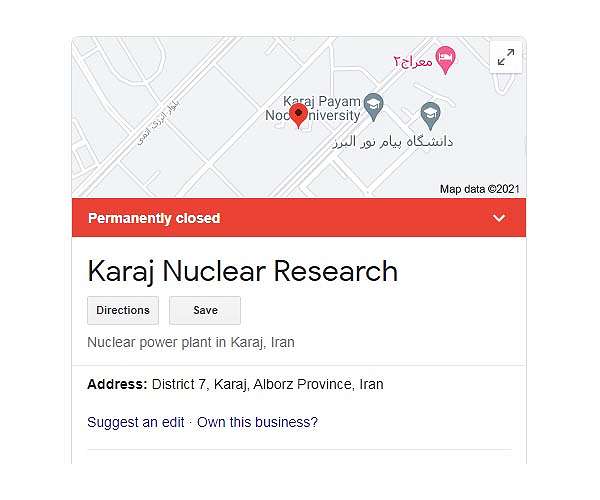
Iran said it had foiled a sabotage attack on an atomic energy agency building on Wednesday, shortly after slamming Washington's blockage of dozens of Iranian media sites as unhelpful for ongoing nuclear talks.
State television said the thwarted "sabotage operation" targeted a building belonging to the Atomic Energy Organization of Iran, without identifying the operation's nature or the culprits.
"The saboteurs failed to carry out their plan," and there were no casualties or damage, state TV reported.
Tasnim news agency said the target building was near the city of Karaj, some 50 kilometres (30 miles) west of the capital Tehran.
The reports came as talks continue in Vienna between Tehran and world powers aimed at reviving their hobbled 2015 nuclear deal, staunchly opposed by Israel, Iran's arch-nemesis and a key ally of the US.
The reported sabotage also comes a day after the US Justice Department said it had seized 33 Iranian government-controlled media websites, alleging they were hosted on US-owned domains in violation of sanctions.
The office of Iran's outgoing president Hassan Rouhani warned on Wednesday that Washington's move was "not constructive" for the nuclear talks, even as Germany's top diplomat Heiko Maas said there was a "good chance" of reviving the deal soon.
– 'Whatever it takes' –
The developments come days after ultraconservative cleric Ebrahim Raisi was elected Iran's next president, in an election the US deplored as neither free nor fair.
The 2015 nuclear deal promised Iran sanctions relief in return for limits on its nuclear programme, but was torpedoed three years later when then US-president Donald Trump unilaterally withdrew from it and reimposed punishing sanctions.
In response, Iran later progressively stepped back from its own commitments under the deal.
Israel has always vigourously opposed the deal, and its new coalition government has pledged to "do whatever it takes to prevent Iran obtaining a nuclear bomb".
Iran has always denied seeking nuclear weapons.
Tehran accuses the Jewish state of being behind a sabotage attack on its Natanz uranium enrichment plant in April and the assassination of its top nuclear scientist Mohsen Fakhrizadeh last November.
Israel has never commented on that killing, and neither confirmed nor denied involvement in the "small explosion" at Natanz. But Israeli public radio said the latter was a sabotage operation by the Mossad spy agency, citing unnamed intelligence sources.
The New York Times also quoted intelligence sources pointing to a "an Israeli role".
Iran's foreign ministry accused Israel of an act of "nuclear terrorism" over Natanz, aimed at scuttling the Vienna talks.
The Vienna dialogue has been spurred by Trump's successor Joe Biden favouring rejoining the accord, even if Tehran and Washington have officially yet to negotiate directly to that end.
– 'Good chance' for deal –
President-elect Raisi, seen as close to supreme leader Ayatollah Ali Khamenei who holds ultimate political power in Iran, said on Monday he would not allow the nuclear negotiations to drag out forver.
He is set to replace Rouhani, a moderate who has served the maximum of two consecutive four-year terms, in August.
Germany, which remains a party to the Iran nuclear agreement alongside China, the UK, France and Russia, struck an upbeat note on Wednesday, while acknowledging challenges remained.
"Regarding the negotiations in Vienna, they aren't easy — that's been clear in recent weeks," Foreign Minister Heiko Maas told journalists in Berlin during a visit by US Secretary of State Antony Blinken.
"Nevertheless we are moving forward step by step in every round of negotiations and we assume that in the context of the (Iranian) presidential election, there's a good chance to conclude them in the foreseeable future."
But Iran warned that the US decision on Tuesday to block dozens of Iran-linked websites was unhelpful for the talks and accused Washington of repressing freedom of expression.
Iranian media sites Press TV and Al-Alam, the country's main English- and Arabic-language broadcasters, were among those affected.
"We are using all international and legal means to… condemn… this mistaken policy of the United States," the director of Rouhani's office, Mahmoud Vaezi, told reporters.
"It appears not constructive when talks for a deal on the nuclear issue are under way."
Wednesday's alleged sabotage attack comes two days after Iran said it had temporarily shut down its only nuclear power plant at Bushehr on the country's Gulf coast, for maintenance work.
The Bushehr plant and its 1,000-megawatt reactor were built by Russia and officially handed over in September 2013, despite concerns over its location in an earthquake-prone area.
Germany sees 'good chance' for striking Iran nuclear deal soon
Berlin (AFP) June 23, 2021 –
German Foreign Minister Heiko Maas said Wednesday that he saw a "good chance" of concluding talks on a revival of the Iran nuclear deal soon, after talks with his US counterpart.
"Regarding the negotiations in Vienna, they aren't easy — that's been clear in recent weeks," Maas told a joint press conference with US Secretary of State Antony Blinken.
"Nevertheless we are moving forward step by step in every round of negotiations and we assume that in the context of the (Iranian) presidential election, there's a good chance to conclude them in the foreseeable future."
Maas said there were still "several technical questions to resolve" on the landmark accord.
"In any case we are convinced that it's worth it to maintain talks over such a long period of time in order to revive the JCPOA in this way."
The 2015 deal known as the Joint Comprehensive Plan of Action (JCPOA) saw Iran accept curbs on its nuclear activities in return for an easing of sanctions.
But in 2018 then US president Donald Trump unilaterally abandoned the agreement and ramped up sanctions, prompting Iran to pull back from its own commitments.
Trump's successor Joe Biden has signalled his readiness to return to the deal and state parties — also including Britain, China, France, Germany and Russia — have been negotiating its revival in Vienna since early April.
Ultraconservative cleric Ebrahim Raisi scored 62 percent of the vote in a presidential election in the Islamic republic last Friday.
Raisi, seen as close to supreme leader Ayatollah Ali Khamenei, who holds ultimate political power in Iran, said on Monday he would not allow the nuclear negotiations to drag on.
EU negotiator Enrique Mora said on Sunday that those involved in the talks were "closer" to saving the Iran nuclear deal but that sticking points remain.
Israel army chief says cooperation with US against Iran 'unprecedented'
Jerusalem (AFP) June 23, 2021 –
Israel's army chief on Wednesday hailed "unprecedented" cooperation with the US, as he wrapped up a US visit focused on preventing Tehran from obtaining military nuclear capabilities.
Lt. Gen. Aviv Kohavi's remarks came the same day as Iran said it had foiled a sabotage attack on an atomic energy agency building, as talks continue in Vienna between Tehran and world powers aimed at reviving their 2015 nuclear deal.
Israel staunchly opposes the deal, which it fears could enable its arch-nemesis to obtain nuclear weapons.
Kohavi's visit, which began on Sunday, also came four weeks since Israel and Gaza's Palestinian Islamist rulers Hamas agreed a ceasefire ending 11 days of heavy fighting.
At the US military's Central Command in Florida, Kohavi met Centcom commander General Frank McKenzie, where he discussed the Gaza war, the Syrian arena and coordination between the countries.
"The IDF's operational cooperation with the US military is unprecedented in its scope and has reached new heights," Kohavi said in a statement, using the acronym for Israel defence forces.
"The mutual and main goal of action for the two armies is thwarting Iranian aggression," he added.
"Iran seeks to establish and entrench terrorists in many countries (and) continues to pose a regional threat in terms of nuclear proliferation, advanced weapons systems including ballistic missile capabilities, and the financing of terrorist armies," the Israeli general said.
Kohavi was also meeting with US National Security Advisor Jake Sullivan on "Iran's regional entrenchment throughout the Middle East and the flaws" of the nuclear deal with Iran, a statement from the military said.
In meetings with Sullivan and CIA head William Burns, Kohavi was "presenting multiple ways to prevent Iran from acquiring military nuclear capabilities," the army said.
Kohavi was due to return to Israel on Friday.
