
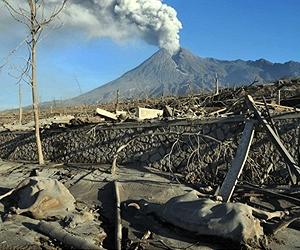
More than 300 people have been killed since Indonesia's Mount Merapi volcano began erupting late last month, an official said Sunday, with more than 200,000 people still living in makeshift camps.
Agam Ferdatama, a disaster management official, said the toll had now reached a total of 304.
"Rescuers have recovered more bodies around the volcano and there were others who died from their burn wounds," he told AFP.
"The number of people living in temporary shelters is 203,449," he added.
The government reduced the exclusion zone on Friday for the second time in a week because of the volcano's declining volatility, allowing more refugees to return to their homes.
Merapi killed around 1,300 people in 1930 but experts say the current eruptions are its biggest since 1872.
earlier related report
Villagers flee as Philippine volcano shoots ash
Manila (AFP) Nov 21, 2010 –
Scores of people were forced to flee their homes after a restive Philippine volcano shot a column of ash into the air on Sunday, showering surrounding villages, authorities said.
Residents of two villages near the 1,565-metre (5,135-foot) Mount Bulusan volcano evacuated their homes after the volcano shot a column of ash some two kilometres into the air.
"The ones evacuated were those most vulnerable to the ash like the children, the elderly, the pregnant and nursing mothers," said disaster control chief Jose Lopez in an interview with ABS-CBN television.
Evacuees were taken to government schools that are being used as relief centres, he added.
More than 750 people have fled their homes since Bulusan started emitting ash on November 6, said Lopez.
One man with asthma already died from Bulusan's ash emissions on November 11, the National Disaster Risk Reduction and Management Council said in Manila.
Government vulcanologists had earlier raised the alert level for Bulusan from zero to level 1, indicating abnormal activity, possibly a sign of more ash eruptions to come.
The government has warned people not to enter a four-kilometre (2.5 miles) "danger zone" around the volcano and communities nearby were told to be on alert for volcanic mudslides caused by heavy rains mixed with ash depositd on Bulusan's slopes.
Bulusan, 250 kilometres southeast of the capital Manila on the main island of Luzon, is one of the country's 23 active volcanoes.
The local government said a quarter million people live in six towns around the volcano, and many of them could be at risk if the mild eruption increases in intensity.
Bulusan has erupted 16 times in recorded history, the last time in 2006. It began emitting ash again from November 6.
The Philippines is part of the Pacific Ring of Fire where frequent volcanic eruptions and earthquakes take place.
Share This Article With Planet Earth
