
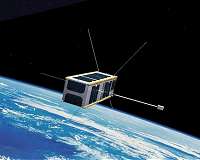
Rifath Shaarook, an 18-year-old student from the south Indian state of Tamil Nadu, has built a satellite which weighs only 64 grams and will be launched by NASA next month.
Shaarook won the competition Cubes in Space, sponsored by NASA and the I Doodle Learning organization.
Shaarook expressed his excitement over the news that his satellite will be launched by NASA. "I belong to Pallapatti, a small place in Tamil Nadu.
I lost my father at a very early age but my mother motivated me to excel in space science, as my father was also interested in astronomy," he told Sputnik.
The world smallest satellite, KalamSat, designed by Shaarook has been named after the former Indian President Dr. APJ Abdul Kalam.
"I am deeply impressed by late former President APJ Abdul Kalam, therefore the name of the satellite KalamSat is a tribute to him," Shaarook told Sputnik.
KalamSat is made from 3-D printed carbon fiber. The satellite will be launched by NASA on June 21 from the Wallops Island, Virginia in a sounding rocket. The mission will last for 240 minutes.
The world's smallest and lightest satellite will be operational in micro-gravity environment of space for about 12 minutes. KalamSat will be used to exhibit how 3D-printed carbon fiber performs in these conditions.
CanX-7 Nanosatellite Shows Drag Sails are Effective at Deorbiting after Just One Week
After the CanX-7 nanosatellite deployed its drag sails only a week ago, early results indicate the sails are having a noticeable effect. Space Flight Laboratory (SFL), which developed CanX-7, has announced the altitude decay rate changed significantly following the deployment in the late evening of 4 May 2017 (Toronto time).
A graph of the altitude decay rate shows the aerodynamic drag on … read more
