
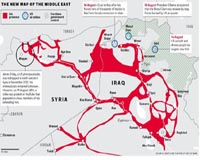
Islamic State jihadists have lost only a tiny fraction of captured territory in Iraq after five months of US-led air strikes, the Pentagon said Friday.
Kurdish peshmerga forces and Iraqi government troops have retaken 700 square kilometers (270 square miles) of ground mostly in northern Iraq, but the IS group still holds 55,000 square kilometers, spokesman Rear Admiral John Kirby told reporters.
That amounts to roughly one percent of IS-held territory changing hands since the US launched air raids in Iraq on August 8.
Kirby acknowledged that not much ground had been gained back so far but said that the air strikes had halted the momentum of the jihadists and bought time for the training of Baghdad government forces.
"I think we all recognize that it's a small percentage of the total right now. But we're only six, seven months into this thing, too," he said.
The US military has made clear the campaign against IS "is going to take time, to uproot these guys and to really get at them," he said.
The Pentagon provided the figures after announcing recently that Iraqi and Kurdish troops had regained 700 square kilometers, without explaining what percentage that represented of all territory held by the IS militants.
By comparison, the Iraqi government held about 77,000 square kilometers and the Kurdish forces controlled roughly 56,000 square kilometers, he said.
Those numbers did not represent the entire territory of Iraq, but only populated, "relevant" areas, according to Kirby.
US commanders have said that the Iraqi army needed to be reorganized and armed before staging a major counter-offensive to roll back the IS from large swathes of territory it seized last year.
The officer overseeing the US-led campaign against the IS group, General Lloyd Austin, head of Central Command, told The Wall Street Journal on Thursday that Iraqi forces would be ready to launch a counter-offensive to recapture the northern city of Mosul by the summer.
Since August 8, there have been nearly 2,000 air strikes in the fight against IS in Iraq and Syria, with American warplanes carrying out more than 1,600 of those raids, defense officials said.
Canadian troops again battle IS group in Iraq
Ottawa (AFP) Jan 26, 2015 –
Canadian special forces have twice exchanged gunfire with Islamic State fighters in Iraq since the first confirmed ground battle between Western troops and IS earlier this month, a senior officer said Monday.
Recalling the first incident, Captain Paul Forget told a briefing: "Two similar events have occurred over the last week and, in both cases, Canadian special operations forces, again acting in self-defense, effectively returned fire, neutralizing the threat."
No Canadians were injured, he added.
The first clash mid-January in which the Canadians came under mortar and machine gun fire while training Iraqi troops near front lines underscored political divisions in Ottawa over the US-led mission against IS.
Canada's opposition leader accused Prime Minister Stephen Harper of having lied when he promised no ground combat alongside coalition airstrikes against the Islamic State group.
An unapologetic Harper said Canadian troops were responding to an evolving threat.
"We want to advise and assist Iraqi forces, particularly the Kurdish forces, to lead the combat themselves," Harper said at a news conference on Thursday.
"But let me be clear, this is a robust mission. We are there to make those guys effective so they can take on the Islamic State and deal with them. If those guys (IS) fire at us, we are going to fire back and we are going to kill them."
Canada sent 69 special forces to train Iraqis, and some 600 air crew and other military personnel — as well as six fighter jets and other military aircraft — to the region in November to participate in air strikes.
The special forces have also designated targets for coalition aircraft.
The opposition has decried what they referred to as mission creep — incremental changes to mission parameters outlined to parliament in September — but Forget said it is a normal "evolution of our advise and assist capacity."
