
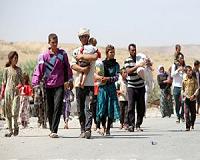
Hungary's Prime Minister Viktor Orban on Thursday defended his hardline stance against refugees, saying that "seventy percent of the migrants are young men and they look like an army".
"What he have been facing is not a refugee crisis," he said in an address to the European People's Party congress, which groups conservative parties from across the European Union, in Madrid.
"This is a migratory movement composed of economic migrants, refugees and also foreign fighters. This is an uncontrolled and unregulated process," he added.
"Right to human dignity and security are basic rights. But neither the German nor the Hungarian way of life is a basic right of all people on the Earth.
Almost 600,000 people fleeing war and poverty, many of them refugees from Syria's civil war, have arrived in Europe so far this year, with the bulk of them heading for Germany and Sweden.
Hungary has responded to the largest migration wave Europe has seen since World War Two by building a steel fence along its borders with Serbia and Croatia, a step both welcomed and criticised by various leaders around Europe.
"We cannot avoid to speak about the quality of our democracies," said Orban.
"Does it comply with the freedom of information and speech that media usually show women and children while seventy percent of the migrants are young men and they look like an army?".
"Just because we do not consider them as enemies we must not act againt ourselves. Our moral responsibility is to give back these people to their homes and countries," Orban said.
Juncker urges EU member states to respect migrant aid pledges
Madrid (AFP) Oct 22, 2015 –
European Commission chief Jean-Claude Juncker on Thursday chided EU member states for not respecting their pledges of humanitarian aid to tackle the migrant crisis, saying "urgency" was needed.
"The migrant crisis which we are experiencing will not be over at Christmas, it is a crisis that will last and long-term action is needed," he told a gathering of European conservative parties in Madrid.
European Union member states pledged a total of 2.3 billion euros ($2.6 billion) in aid to tackle the crisis but so far have only deliver 275 million euros, he said.
"Let's not write poems or make promises, let's act because there is urgency," said Juncker.
"We must be conscious of our responsibility," he added.
Juncker invited eight EU leaders and their Serbian and Macedonian counterparts to Brussels on Sunday to tackle the migrant crisis along the western Balkans route.
The summit comes as crowds of refugees and other migrants camp by roads in western Balkan countries in worsening autumn weather after Hungary sealed its borders with Serbia and Croatia, causing a chain reaction in other overwhelmed states.
The eight leaders from the 28-nation EU who are invited to the mini summit are those from Austria, Bulgaria, Croatia, Germany, Greece, Hungary, Romania and Slovenia.
A dividing line is emerging between governments that see the crisis primarily as a security issue requiring stronger action to control the EU's borders, stem the flow of migrants, send back those not entitled to asylum and pay other states if necessary to keep them at bay, and those that see it above all as a humanitarian integration challenge.
Just before Juncker spoke, EU Council President Donald Tusk took the stage to call for the strengthening of the bloc's external borders.
"We have lost the capacity to defend our borders," the former Polish prime minister said.
"We must end the useless debate between those who want to defend borders…and those who support solidarity and openness," he added.
Among those in attendance were German Chancellor Angela Merkel, who has opened Germany's gates to the lion's share of new arrivals, and Hungarian Prime Minister Viktor Orban who has taken a hardline stance against refugees.
