
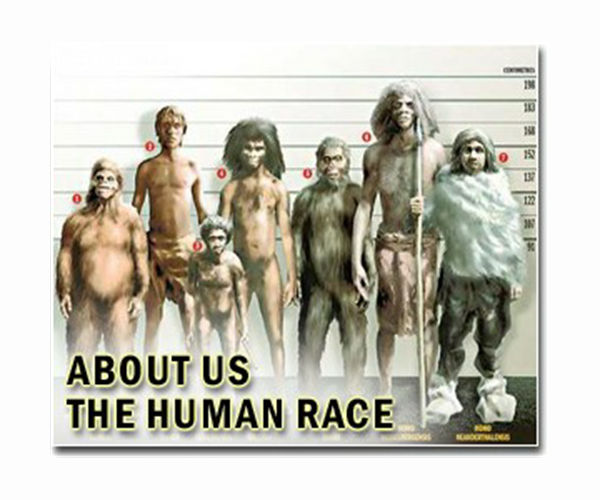
New analysis of hundreds of human fossils, some 1 million years old, suggests the average human body size has fluctuated as the planet's climate periodically warmed and cooled.
According to the new study, published Thursday in the journal Nature Communications, cold, harsh climates fueled increases in body size, while warmer climates triggered declines in body size.
Scientists found the size of the human brain also fluctuated over time, but the changes were not synced with shifts in body size.
For the study, scientists in Britain and Germany teamed up to analyze 300 fossils from the genus Homo, collected from all over the globe. Using the fossil data, researchers plotted changes in brain and body size across time and space.
Scientists also reconstructed temperature changes across regional climates during the last 1 million years. When researchers compared the two datasets, they found temperature changes were strongly correlated with shifts in body size.
Modern humans, or Homo sapiens, emerged around 300,000 years ago in Africa, but our closest relatives, Neanderthals, were around 400,000 years ago, and other earlier hominin species, including Homo habilis and Homo erectus, emerged as early as 2 million years ago.
The bodies of modern humans are 50 percent bigger than Homo habilis, while our brains are roughly three times larger.
For decades, scientists have debated the source of these significant physiological differences.
"Our study indicates that climate — particularly temperature — has been the main driver of changes in body size for the past million years," lead author Andrea Manica said in a press release.
"We can see from people living today that those in warmer climates tend to be smaller, and those living in colder climates tend to be bigger. We now know that the same climatic influences have been at work for the last million years," said Manica, a reasearcher in the zoology department at the University of Cambridge.
Though scientists noted significant fluctuations in brain size among the fossil data, the analysis revealed only a very weak link between brain size and temperature.
However, when researchers looked at the relationship between brain size and habitat type, they found bigger brain sizes were associated with stable but sparsely vegetated ecosystems, such as open steppes and grasslands, where humans were able to track and hunt large animals.
"There is an indirect environmental influence on brain size in more stable and open areas," said first author Manuel Will, researcher at the University of Tubingen in Germany. "The amount of nutrients gained from the environment had to be sufficient to allow for the maintenance and growth of our large and particularly energy-demanding brains."
Scientists estimate a variety of non-climate factors — including the demands of increasingly complex social lives, diet diversification and sophisticated tool-making — likely drove changes in brain evolution.
Researchers suggest evolutionary changes in brain and body size continue today. As the planet warms, it's likely the human body will get smaller, and the authors of the latest study hypothesize that the human brain may also shrink as more and more complex tasks are outsourced to computers.
"It's fun to speculate about what will happen to body and brain sizes in the future, but we should be careful not to extrapolate too much based on the last million years because so many factors can change," said Manica.
