
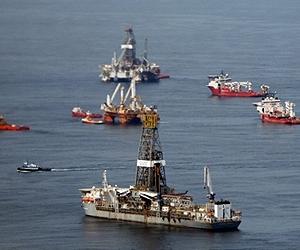
On a pivotal day for the Gulf of Mexico oil disaster, BP plugged its stricken well while officials announced Wednesday that most of the toxic crude has been cleaned up or dispersed through natural processes.
Though undoubtedly the best day since the disaster began more than 15 weeks ago, US officials cautioned that a great deal of clean-up work remained and that the long-term impact could be felt for years, even decades, to come.
BP's long-awaited "static kill" was conducted overnight as heavy drilling fluid was rammed into the busted Macondo well for eight hours, forcing the oil back down into the reservoir miles beneath the seabed.
We "have reached a static condition in the well that allows us to have high confidence that there will be no oil leaking into the environment," US spill response chief Thad Allen told reporters at a White House briefing.
The breakthrough came 106 days after a devastating explosion aboard the BP-leased Deepwater Horizon rig on April 20 killed 11 workers and unleashed a torrent of oil into the Gulf.
"So, the long battle to stop the leak and contain the oil is finally close to coming to an end. And we are very pleased with that," US President Barack Obama said. "Our recovery efforts, though, will continue. We have to reverse the damage that's been done."
Officials and experts were discussing whether to seal the reservoir with cement now or wait until a relief well is finished mid-August — this decision hinges on the presence, or not, of any leaks in the steel casing of the well.
The best case scenario could see the well put permanently out of action in days, although the "bottom kill" will still be performed through a relief well by the end of month to cement in the outer well bore and make sure of success.
At 4.9 million barrels, the disaster is the biggest maritime spill on record.
It threatened the fish and wildlife-rich US Gulf coast with environmental ruin and plunged residents of coastal communities into months of anguish over their livelihoods and the region's future.
A report by the National Oceanic and Atmospheric Administration (NOAA) and the Department of the Interior published Wednesday revealed that some 74 percent of the oil is now accounted for.
The remaining 26 percent — or about 1.3 million barrels of oil — was classified as "residual oil" and "is either on or just below the surface as residue and weathered tar balls, has washed ashore or been collected from the shore, or is buried in sand and sediments," the report said.
A team of scientists which has been carefully tracking the spill determined that a third of the oil was captured or mitigated through burning, skimming, chemical dispersion and direct recovery from the wellhead.
NOAA chief Jane Lubchenco, speaking alongside Allen at the White House, explained that a further 41 percent has evaporated or is being dispersed into microscopic droplets through natural processes.
"I think it's important to point out that at least 50 percent of the oil that was released is now completely gone from the system," she said. "And most of the remainder is degrading rapidly, or is being removed from the beaches."
But Lubchenco was quick to stress that scientists will not be able to determine for a long time the full extent of the damage.
"We remain concerned about the long term impact," she said, adding that it could be felt, "for years and possibly decades to come."
Huge swaths of the Gulf remain closed to fishing, and even when fishermen are able to fill their nets they fear consumers might not believe the seafood is safe to eat.
With tourists likely to avoid Gulf beaches for years and oil industry jobs under threat from Obama's moratorium on new deep sea drilling permits, the future remains bleak for many coastal communities.
BP, meanwhile, is hoping to rebuild its shattered reputation but must also meet the claims of thousands of individuals and businesses whose livelihoods have been washed away, while a mammoth civil trial looms.
BP senior vice president Kent Wells expressed relief that 20 days after the flow of oil in the sea was stemmed with a temporary cap "it's very difficult for us to find any oil anywhere on the surface."
He refused, however, to declare victory until the well is permanently sealed.
Gulf of Mexico disaster is biggest maritime spill ever
New Orleans, Louisiana (AFP) Aug 3, 2010 –
New official figures on the eve of BP's well kill operation on Tuesday showed that the Gulf of Mexico oil disaster is now the biggest maritime spill ever.
The US government's flow assessment team said 4.9 million barrels (205.8 million gallons) of oil gushed from the ruptured Macondo well before a cap placed over the wellhead finally sealed it on July 15.
They said the figure was correct to within 10 percent, meaning the wider estimate is somewhere between 4.41 million barrels and 5.39 million barrels.
BP captured approximately 800,000 barrels of oil with its various containment devices, meaning the amount of crude that spewed into the Gulf was somewhere between 3.61 million barrels and 4.59 million barrels.
Here is a list of the largest spills ever recorded in order of size:
– 1910: CALIFORNIA: The Lakeview Gusher Number One in Kern County, California is regarded as the largest oil spill in history, lasting 18 months and releasing nine million barrels of crude oil, but it was on land.
– 1991: GULF WAR: The only maritime contender that could possibly rival the Gulf of Mexico spill was deliberate not accidental, when Iraqi forces set fire to Kuwaiti oil wells during the Gulf War. Original estimates put the volume at around 11 million barrels but later studies suggested somewhere between two and six million barrels were unleashed.
– 1979: GULF OF MEXICO: Around 3.3 million barrels gushed from the Ixtoc-1 well after an explosion on a rig operated by the Mexican state oil company Pemex. Capping the leak took nine months.
– 1979: WEST INDIES: Two tankers — the Atlantic Empress and Aegean Captain — collided and caught fire during a tropical storm off Tobago, spilling an estimated 2.1 million barrels of crude in the largest ship-sourced spill to date.
– 1994: SIBERIA: An estimated 733,000 to 2.1 million barrels spill from a ruptured pipeline in Russia's Komi Republic.
– 1991: ANGOLA: Loaded with 1.9 million barrels of Iranian crude, the ABT Summer explodes some 1,500 kilometers (900 miles) off the coast of Angola. The ship and a large slick burned for days, but the bulk of the oil did not reach land.
– 1978: FRANCE: 1.6 million barrels of crude wash up on 400 kilometers of coastline when the Liberian-registered supertanker Amoco Cadiz sank off the western tip of Brittany.
– 1967: BRITAIN: 880,000 barrels of oil polluted the southern coast of England, and also French coasts, after the grounding of the Torrey Canyon supertanker.
– 1996: BRITAIN: Some 530,000 barrels of crude spill into the ocean when the Sea Empress went aground off Wales, polluting 200 miles of pristine coast — much of it in a national park.
– 1989: UNITED STATES: The Exxon Valdez runs aground in Prince William Sound, Alaska, spilling 271,000 barrels of oil and impacting 1,770 kilometers of coast in what had been the worst US environmental disaster to date.
Share This Article With Planet Earth
