
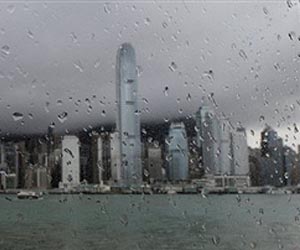
Hong Kong's government warned Monday it will take further steps to dampen the city's red-hot property market if necessary, after measures last week saw sales plunge and developers' share prices drop.
Financial Secretary John Tsang last Friday unveiled a range of measures aimed at restraining property prices in the densely populated former British colony, a favourite destination for super-rich mainland Chinese investors.
The move followed public anger at spiralling property prices in Hong Kong — traditionally associated with laissez-faire policies — and a warning from the IMF of a potential bubble.
The measures appeared to have an immediate impact, even though they have yet to be passed by the city's lawmaking body, the Legislative Council, with secondary residential home sales plummeting over the weekend.
Ricacorp, one of Hong Kong's largest real estate agents, said sales had fallen by 70 percent on Saturday and Sunday compared to the previous week.
"Clients are postponing signing contracts," managing director Willy Liu told AFP.
Raymond Chan, regional sales director of Midland Realty, told AFP that sales of newly built properties had also dipped.
"We expected a blow-out sale for a property launch last Friday, but it only sold around two thirds, far short of our expectations," he said.
In an attempt to discourage property speculation, as of the weekend, anyone reselling a property within six months of purchase is subject to a 15 percent stamp duty.
A 10 percent duty applies to sales between six and 12 months and five percent between 12 and 24 months.
The head of the Hong Kong Monetary Authority, the city's de facto central bank, also outlined measures tightening the availability of mortgages.
The market reacted strongly to the announcement Monday with real estate stocks retreating and the Hang Seng Index losing 81.69 points, closing at 23,524.02 on turnover of 79.65 billion Hong Kong dollars (10.27 billion US).
Among Hong Kong developers, Cheung Kong dropped 3.23 percent, Sun Hung Kai Properties fell 3.05 percent and Henderson Land ended down 2.29 percent. Midland Holdings, the owner of Midland Realty, slumped 17.43 percent due to concerns about a slide in transaction volumes.
"The new measures could immediately dampen sentiment — further measures could also be introduced if the desired results aren't achieved," Francis Lun, general manager of Fulbright Securities, told Dow Jones Newswires.
Hinting of further action if the first dose to cool the feverish property market does not work, Tsang pledged that he "will not turn a blind eye to the risks affecting our economy and financial stability."
Writing in his blog on Sunday he said the city needs to be "decisive" in mitigating the risks posed by the asset bubble.
"It unsettles me to know that speculators are capitalising on market sentiments… to make profits."
Meanwhile, broad support from lawmakers for the measures was tempered by concerns the changes may sting first-time buyers looking to secure large mortgages.
Speaking in a legislative council session on Monday legislator Albert Chan said: "This is one of the rare bold moves by the government. But… this would inadvertently catch the wrong guy."
Share This Article With Planet Earth
