
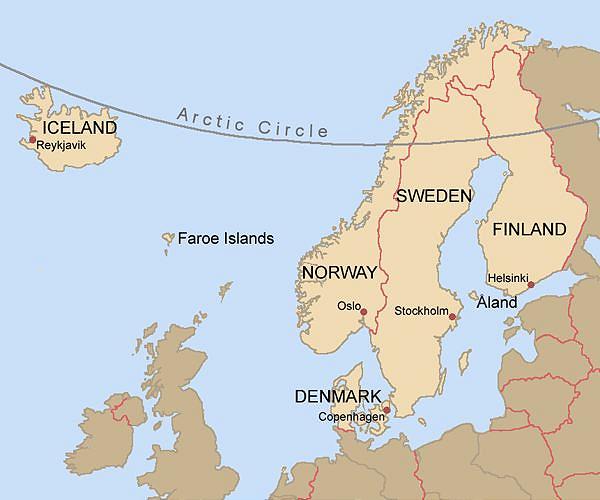
Meteorologists across the Nordic countries have registered near-record temperatures over the weekend, including highs of 34 degrees Celsius (93.2 degrees Fahrenheit) in some places, news agencies reported Monday.
The latest figures came after Finland's national meteorological institute registered its hottest temperature for June since records began in 1844.
Kevo, at the far north of Finland, recorded heat of 33.5 degrees Celsius on Sunday, the hottest since 1914 when authorities registered 34.7 degrees Celsius, said the STT agency.
Several parts of Sweden also reported record highs for last month.
"June 2021 was the hottest June ever recorded in my hometown Stockholm by a large margin," climate campaigner Greta Thunberg tweeted.
"The second hottest June was in 2020. The third in 2019," she added.
"Am I sensing a pattern here? Nah, probably just another coincidence."
At a national level, June 2021 was the third-hottest ever recorded in Sweden.
And Norway's meteorological institute registered 34 degrees Celsius in Saltdal, a county near the Polar Circle.
That is the highest temperature measured in the country this year, and just 1.6 degrees Celsius short of Norway's all-time record.
Several parts of the world have already experienced crushing heatwaves this year.
Canada is battling a string of forest fires in the western province of British Columbia after sweltering under temperatures of up to 49.6 degrees Celsius, a new national record.
On Thursday, the United Nations confirmed a new record high temperature for the Antarctic continent — measured last year — of 18.3 degrees Celsius.
Climate change link as New Zealand records warmest June on record
Wellington (AFP) July 6, 2021 –
New Zealand recorded its hottest June on record as temperatures continued to soar in a pattern consistent with global warming, a government scientific agency said Tuesday.
Daily temperatures averaged 10.6 Celsius (51.1 Fahrenheit) — 1.9C above average despite a cold snap late in the month, the National Institute of Water and Atmospheric Research (NIWA) said.
"It's huge. There's only been 13 times since 1909 that we've had such an anomaly," NIWA scientist Chris Brandolino told public radio.
"What's alarming is that over the past 10 years that's happened six times."
Brandolino said that while shorter-term factors such as warmer ocean temperatures helped heat the air over New Zealand, climate change was a constant underlying factor.
"We've had more north-easterly air flows than normal (from the Pacific), so they're coming from a warm place, and ocean temperatures are also warmer than average," he said.
"Then you throw in the background of climate change and it adds up to a record warm month for June."
New Zealand had its seventh-hottest year in 2020, which was also the seventh year in a decade that temperatures have been in the top 10 highest ever recorded.
The country's centre-left Prime Minister Jacinda Ardern declared a 'climate emergency' last year, saying urgent action was needed for the sake of future generations.
New Zealand has committed to becoming carbon neutral by 2050 and to generating all its energy from renewable sources by 2035.
Climate change link as New Zealand records warmest June on record
Wellington (AFP) July 6, 2021 –
New Zealand recorded its hottest June on record as temperatures continued to soar in a pattern consistent with global warming, a government scientific agency said Tuesday.
Daily temperatures averaged 10.6 Celsius (51.1 Fahrenheit) — 1.9C above average despite a cold snap late in the month, the National Institute of Water and Atmospheric Research (NIWA) said.
"It's huge. There's only been 13 times since 1909 that we've had such an anomaly," NIWA scientist Chris Brandolino told public radio.
"What's alarming is that over the past 10 years that's happened six times."
Brandolino said that while shorter-term factors such as warmer ocean temperatures helped heat the air over New Zealand, climate change was a constant underlying factor.
"We've had more north-easterly air flows than normal (from the Pacific), so they're coming from a warm place, and ocean temperatures are also warmer than average," he said.
"Then you throw in the background of climate change and it adds up to a record warm month for June."
New Zealand had its seventh-hottest year in 2020, which was also the seventh year in a decade that temperatures have been in the top 10 highest ever recorded.
The country's centre-left Prime Minister Jacinda Ardern declared a 'climate emergency' last year, saying urgent action was needed for the sake of future generations.
New Zealand has committed to becoming carbon neutral by 2050 and to generating all its energy from renewable sources by 2035.
