
More than $20 million in state property taxes are on the line amid shows of civil disobedience over an Enbridge oil pipeline, a Minnesota trade group said.
Public hearings of plans by Enbridge Energy to overhaul its Line 3 pipeline through Minnesota were cancelled by authorities in St. Cloud because of "logistical and safety issues" at a convention center. The Minnesota Petroleum Council said it was unfortunate that those working to "actively obstruct civil discourse, stifle free speech, and disrespect those in attendance" were interfering with public vetting.
"It's estimated that the Line 3 replacement project would support thousands of Minnesota jobs and generate an estimated $20 million per year in state property taxes," Executive Director Erin Roth said in a statement. "We hope that this cancellation is an isolated incident and look forward to our continued participation in these hearings throughout Minnesota."
Enbridge said replacements and upgrades to the 50-year-old system are the most efficient way to ensure the infrastructure is reliable. In testimony submitted to the state Public Utilities Commission, the company stressed that operating a 50-year-old pipeline that has a regular maintenance program carries more potential risk of a release than a "newly constructed, modern pipeline."
The proposal for Line 3 includes a $4.2 billion Canadian component and a $2.9 billion U.S. component. Enbridge said replacements and upgrades to the system are the most efficient way to ensure the infrastructure is reliable.
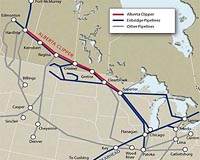
The State Department last week said Enbridge could build a three-mile section of its Alberta Clipper oil pipeline across the national border. The company three years ago connected Alberta Clipper to its existing Line 3 pipeline through Minnesota while it waited for approval for the new cross-border section.
The PUC said it was reviewing a time to reschedule the cancelled hearings. Pipeline opponents said the cancellation was "a blatant sign of racism" because many of those protesting were from the indigenous community.
The PUC is expected to make a decision on the project by early 2018
Raton Basin earthquakes linked to oil and gas fluid injections
A rash of earthquakes in southern Colorado and northern New Mexico recorded between 2008 and 2010 was likely due to fluids pumped deep underground during oil and gas wastewater disposal, says a new University of Colorado Boulder study.
The study, which took place in the 2,200-square-mile Raton Basin along the central Colorado-northern New Mexico border, found more than 1,800 earthquakes up … read more
