
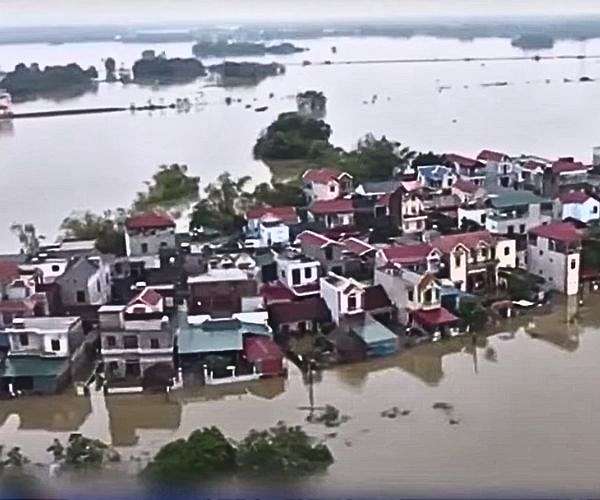
Residents of Vietnam's capital waded through waist-deep water Wednesday as river levels hit a 20-year high and the toll from the area's strongest typhoon in decades rose to at least 179, with neighbouring nations also enduring deadly flooding and landslides.
Typhoon Yagi hit Vietnam at the weekend, carrying winds in excess of 149 kilometres (92 miles) per hour and a deluge of rain that has also brought destructive floods to northern areas of Laos, Thailand and Myanmar.
The Red River in Hanoi reached its highest level in 20 years on Wednesday, forcing residents to trudge through waist-deep brown water as they retrieved possessions from flooded homes.
Others fashioned makeshift boats from whatever materials they could find.
"This was the worst flooding I have witnessed," said Nguyen Tran Van, 41, who has lived near the Red River in Hanoi for 15 years.
"I didn't think the water would rise as quick as it did. I moved because if the water had risen just a bit higher, it would have been very difficult for us to leave," Van told AFP.
A landslide smashed into the remote mountain village of Lang Nu in Lao Cai province, levelling it to a flat expanse of mud and rocks strewn with debris and laced by streams.
State media said at least 34 people had been killed in the village, with another 46 still missing.
Villagers laid dead bodies on the ground, some in makeshift coffins, some wrapped in cloth, while police with picks and shovels dug through the dirt in search of more victims.
Vietnamese state media said the total death toll from Yagi — the strongest storm to hit northern Vietnam in 30 years — had risen to 179, with 145 missing across the country.
– Worst floods since 2008 –
Mai Van Khiem, head of the national weather bureau, told state media that the water level in the Red River in Hanoi was at its highest since 2004.
Forecasters said the waters in Hanoi had peaked and the river level would go down, but Khiem warned of serious widespread flooding in the provinces surrounding the capital in the days ahead.
Police, soldiers and volunteers helped hundreds of residents along the banks of the swollen river in Hanoi to evacuate their homes in the early hours as the water rose rapidly.
A police official in Hanoi, who refused to be identified, said officers were going on foot or by boat to check every house along the river.
"All residents must leave," he said. "We are bringing them to public buildings turned into temporary shelters or they can stay with relatives. There has been so much rain and the water is rising quickly."
Images on Tuesday showed people stranded on rooftops and victims posted desperate pleas for help on social media, while 59,000 people were forced to evacuate their homes in Yen Bai province.
The United States is providing $1 million in immediate humanitarian aid to Vietnam, its embassy in Hanoi said.
– Region-wide impact –
In neighbouring Laos, authorities evacuated 300 people from 17 villages in northern Luang Namtha province, deputy district chief Sivilai Pankaew told AFP.
The UN's World Food Programme said it was "very concerned" for the safety of communities in northern Laos, while national radio reported extensive damage to houses, roads, markets, schools and farmland.
State media said at least one person had been killed and images showed rescuers working in murky brown floodwaters.
Thai authorities said four people were killed in the kingdom's northern provinces of Chiang Mai and Chiang Rai and the army had been deployed to help around 9,000 families hit by floods.
In Myanmar, days of rain around the sprawling low-rise capital Naypyidaw sent river levels to danger levels, the junta said in a statement.
Lay Shwe Zin Oo, from the ministry of social welfare, told AFP that casualties were expected but search teams were still gathering information.
Posts on social media showed people clinging to trees as the waters ran below them.
Southeast Asia experiences annual monsoon rains but human-made climate change is causing more intense weather patterns that can make destructive floods more likely.
Typhoons in the region are forming closer to the coast, intensifying more rapidly, and staying over land longer due to climate change, according to a study published in July.
Flash floods in the wake of Typhoon Yagi have brought destruction to northern Laos, inundating villages and farmland, putting hydropower dams under strain and claiming at least one life, officials, locals and state media said Wednesday.
The rugged, mountainous provinces of Luang Namtha and Phongsaly are worst hit, with footage from state broadcaster Lao National Television showing residents sheltering on upper floors and wading chest-deep through murky brown waters.
Floods and landslides have affected swathes of northern Vietnam, Thailand and Myanmar after Yagi brought days of intense rainfall.
A tour guide in Luang Namtha told AFP the water rose by two to three metres (6.5 to 10 feet) in the space of just 40 minutes on Monday.
"People have lost their livelihoods, their houses and businesses," he said, on condition of anonymity to speak freely.
"Seeing all these people with their belongings and everything is gone."
It is difficult to get a clear picture of the situation in Laos, where the authoritarian communist government tightly controls what information it releases and state media outlets have largely emphasised official relief efforts.
But the UN's World Food Programme said it was "very concerned" for the safety of communities in northern Laos, in a Facebook post.
Luang Namtha deputy district chief Sivilai Pankaew told AFP his team had evacuated more than 300 people from 17 villages.
Aerial images of the provincial capital Luang Namtha showed most of the town of 50,000 residents swamped by opaque brown floodwaters.
Rescue workers navigated the town by motor boat as dozens of people waited for help on upper storeys.
The owner of a guest house on the bank of the Nam Tha river whose property was flooded told AFP the waters had receded but left a thick brown residue of mud behind.
"Everywhere in Namtha is flooded," she told AFP, requesting anonymity.
"Maybe in a month it'll be better but right now I don't think we can take bookings."
The floods have also disrupted operations at some of the several Chinese-run hydroelectric facilities in the area.
"Flooding in Luang Namtha affected Nam Tha dam 3 which is now shut and cannot generate power," Pankaew said.
Officials quoted in state media denied claims from locals that authorities opened floodgates on the dam to relieve pressure without warning residents.
In Phongsaly province, houses, roads, markets, and schools have been inundated and crops have suffered extensive damage, Laos National Radio reported.
Coach of Thai cave boys trapped again – by typhoon floods
Bangkok (AFP) Sept 11, 2024 –
The coach of the young Thai football that captured the world's attention when they spent nearly three weeks trapped in a cave has found himself in another watery predicament — stuck on his roof by flash floods.
Ekkapol Chantawong told AFP on Wednesday he was drawing on his 2018 experience with the "Wild Boars" team to get through his latest ordeal at his home in the northern Thai district of Mae Sai.
Days of torrential rain brought by Typhoon Yagi have triggered deadly flash floods and landslides in northern Thailand, Vietnam, Laos and Myanmar.
The floodwaters rose suddenly in Ekkapol's village early on Tuesday morning, leaving him and his family no time to escape, he told AFP by phone.
The waters kept rising, eventually forcing him onto the roof of his house, where he spent Tuesday night along with his girlfriend and her aunt.
"I was scared but I told myself I have to be calm. Wait and assess the situation," he said.
The waters have gone down, allowing Ekkapol to reach the ground floor of the house, but they cannot leave because the current outside is still too strong, he said.
Ekkapol and his "Wild Boars" team spent nearly three weeks trapped by flash floods in the Tham Luang cave complex, emerging to global acclaim after a daring international rescue operation.
He said the cave experience had taught him lessons he could apply to his latest predicament.
"I do not think it is different. First we have to focus and start solving the problem we are facing," he said.
"I do not feel more pressure with this stranding. I see more of a way out."
Asked if he could imagine a third such experience, Ekkapol laughed: "It's hard to say. We can't say what will be, but I hope I don't have to go up on the roof again tonight."
