
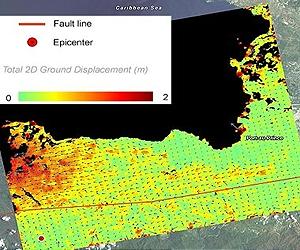
The magnitude 7.0 earthquake that struck Haiti in January, killing a quarter of a million people, also unleashed a string of tsunamis on the country's western coast, scientists reported on Sunday.
Several waves measuring up to 75 centimetres (two and a half feet) were caused by a combination of earth movement and coastal landslides.
They included banks of sediment on the sea bed, accumulated at river deltas, which were displaced by the shock and unleashed the waves as they moved, the study says.
Waves were reported west, north and south of the epicentre, which was within a few kilometres (miles) of the surface on the Enriquillo-Plaintain Garden fault, on the boundaries of two microplates in the Caribbean.
Such "slide-generated" tsunami are rare, but their risk is underestimated, according to the paper, published online in the journal Nature Geoscience.
"Even modest, predominantly strike-slip earthquakes can cause potentially catastrophic slide-generated tsunami," it says.
A strike-slip earthquake occurs when one side of the fault moves along horizontally and in parallel to the other side of the fault, rather than down or up.
Vertical displacement, especially of the seabed, is best known for creating tsunamis.
The study was led by a team led by Matthew Hornbach of the University of Texas at Austin.
The January 12 quake was in tectonic terms a surprisingly complex affair, according to new research. Two-thirds of the movement was strike-slip, and a third was a thrust, or upward, movement.
The quake inflicted huge damage to the capital, Port-au-Prince, injuring 300,000 people and leaving 1.5 million homeless.
earlier related report
Indonesia flood toll rises to 148: official
Jakarta (AFP) Oct 10, 2010 –
The death toll from flash floods that struck a remote region of eastern Indonesia last week climbed to at least 148 Sunday, with more than a hundred people still missing, an official said.
Rescue workers were still searching for survivors from the floods that hit West Papua province's Teluk Wondama district last Monday following torrential downpours, Disaster Management Agency spokesman Priyadi Kardono told AFP.
"At least 148 people were killed. About 123 people are still missing and the chances of them being found alive is slim. They could have been buried under rocks or swept to the sea," he said.
About 700 people were injured, 172 badly, Kardono said.
Those killed had reportedly drowned and been swept away by the powerful waters along with uprooted trees, rocks and debris.
Experts warned such events will become more common in the archipelago due to a combination of climate change, land conversion and logging, which can contribute to landslides and flash floods after monsoonal downpours.
Indonesia's climatology agency said most parts of Indonesia had experienced torrential rains, strong winds, high waves and flooding due to extreme weather this year.
Share This Article With Planet Earth
