
Cirque du Soleil's founder, who will rocket into space in September, went from pauper to circus mogul by turning a troupe of ragtag street performers in 1984 into a global entertainment empire.
Canadian Guy Laliberte, 49, an eternal dreamer with a keen business sense, an impish smile and a shaved scalp is said to be as much at ease walking on stilts as steering his circus dynasty, valued by Forbes magazine at three billion dollars.
From Auckland to Zurich, the Cirque du Soleil has traveled the world over, setting up its big tops in vacant city lots for weeks at a time, as well as permanent installations in Las Vegas, Walt Disney World in Florida, and next year in Dubai.
Its bold acrobatics set in mystical and colorful scenes have thrilled more than 80 million people to date. Nineteen shows, including "Alegria," "O," "The Beatles' Love" and "Zumanity" are currently touring.
The key to the Cirque's success is arguably its mutation of circus feats into plot-driven theater, coupled with haunting music.
This simple idea gave rise to a new form of entertainment and made Laliberte its dominant force. Whether under roving big tops or specially-built odeums, every show has his special stamp.
Laliberte's winged rise to 261st richest man in the world, with a personal fortune valued at 2.5 billion dollars, had not been foreseen in his early life.
At 14 years, he left home.
Four years later, with only 50 dollars in his pocket he headed for France, where he learned to busk, doing stilt-walking and fire-breathing for tips on the streets of European cities.
"One day, I was hitchhiking in France, a car stopped. The driver was a doctor. Not only did he give me a ride all the way to Rennes, he also invited me to stay with him so that I didn't have to sleep outdoors overnight," Laliberte told the Figaro newspaper last year.
It was a pivotal moment in his life, he explained.
He stayed there two weeks and took in what would form the foundation of all he has built: "If you nourish the circle of life, life gives back," he said.
Back in Canada, Laliberte joined a band of street performers in Baie-Saint-Paul, Quebec, known as le Club des Talons Hauts (the High Heels Club).
Two years later, in 1984, he obtained a government grant to organize a show for the 450th anniversary of French explorer Jacques Cartier's discovery of Canada.
The Cirque du Soleil was born.
It was an instant success, and Cirque caravans set out for cities throughout Canada and the United States, its performers drawing ovations night after night.
In the early 1990s its iconic striped big tops were erected in Paris, London and Tokyo, while the company built its first semi-permanent installation at the Mirage Hotel on the Las Vegas strip.
It was in this desert oasis in 2006, that Laliberte, by now an influential entertainment tycoon and jet-setter, introduced "Love" — a tribute to the Beatles.
Its launch brought together for the first time in decades former Beatles Paul McCartney, Ringo Starr, John Lennon's widow Yoko Ono and George Harrison's widow Olivia.
Now, Laliberte is looking to breach a new frontier — space.
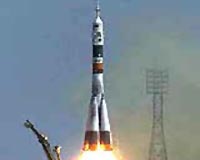
In September, he will fly aboard a Soyuz rocket to the International Space Station, as a tourist.
"I've been introduced in a number of different ways in the past as a fire-eater, an artist, an entrepreneur, an entertainer, and I have to admit that today being introduced as a space explorer is quite something for me," he told a news conference Thursday.
"I am profoundly touched by this," he said, recalling a television interview during the Cirque's early years in which he quipped: "One day I hope I can take the Cirque du Soleil into space."
"Twenty-five years on, I am realizing that that dream can become a reality."
Share This Article With Planet Earth
