
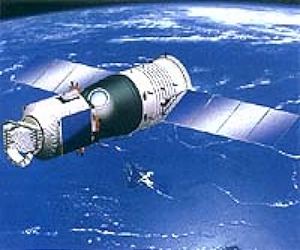
The launch of China's Shenzhou 10 spacecraft has capped a nominal sequence of preparing and rolling out its Long March 2F launch vehicle to its pad at Jiuquan. The lead-up to this launch has followed a predictable course, both in the activities and the timing of key steps in the process.
We have seen so many Shenzhou missions readied for flight that we are now fairly sure of what to expect. In some ways, the launch of Shenzhou 10 is like the Bill Murray movie "Groundhog Day", where the same events are repeated in a time loop on the same day. Like Murray's character, China is also getting better with each cycle.
China seems to have settled on the basic design of the Shenzhou spacecraft and the procedures for launching it, although they still continue to make minor adjustments to the hardware for successive launches.
This suggests that the overall modus of the program works well. At some point in the future, China may elect to speed up or streamline the way certain pre-launch events are carried out, but we can probably expect the current practices to remain in place for a few years.
Shenzhou 10 is expected to fly independently in orbit for roughly two days while it chases the Tiangong 1 laboratory module. The three astronauts on board the spacecraft will adjust to life in space and put their vehicle through its paces. When all is judged ready, Shenzhou 10 will approach Tiangong 1 and the two vehicles will eventually dock.
The two-day flight to Tiangong was previously demonstrated on the uncrewed Shenzhou 8 mission and the Shenzhou 9 mission, which carried the first crew to this laboratory. It's a flight profile that's reminiscent of a typical flight of a Russian Soyuz spacecraft to the International Space Station, which normally takes roughly the same time.
Recently, Soyuz missions to the Station were fast-tracked to allow docking roughly six hours after launch, and two Soyuz craft have already flown this mission profile. It's possible that Shenzhou spacecraft will eventually dock more quickly, but this analyst does not expect China to change its two-day plan in the near future.
The mission of Shenzhou 10 is off to a good start, but challenges lie ahead. Rendezvous and docking is always tricky and potentially dangerous, even to space programs with decades of experience. This mission will also test the performance of the Shenzhou spacecraft beyond any previous crewed mission.
Analysts will also watch the landing of Shenzhou 10 closely. Its predecessor returned to Earth safely, but experienced a bumpy touchdown. Hopefully the crew of Shenzhou 10 will enjoy a smoother ride home.
