
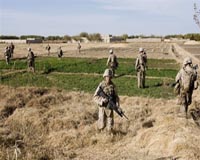
US soldiers at the sharp end of the anti-Taliban war said rampant corruption and ordinary Afghans' hostility risked undermining President Barack Obama's big troop push.
"There needs to be more things done before more troops can arrive because there's too much corruption," said Specialist Daniel Halladay, shortly before Obama's speech was broadcast in Afghanistan.
Halladay, who has spent 11 months in Afghanistan helping to train the fledgling Afghan army, said: "I don't think we have the resources right now to support that kind of influx, although it's definitely a good thing.
"But we need a better priority, we need to work from the top to the bottom, we need to get rid of corruption in the top parts of the Afghan government. We need to work on the government first, and then the rest will fall into place."
Obama late Tuesday announced an immediate surge of 30,000 troops for Afghanistan, vowing to defeat the Taliban and Al-Qaeda militants once and for all after eight years of war and pledging to bring troops home after 18 months.
He warned the Afghan government of President Hamid Karzai that the days of a US "blank cheque" were over, demanding a drive against corruption while promising more support to build up Afghan security forces.
Most of the US soldiers willing to be interviewed at Bagram Airfield said they doubted swelling their ranks alone would help the war effort, so soon after Karzai swept back to power in a fraud-tainted vote.
The soldiers spoke to AFP in the presence of a media liaison officer, at a mess facility at the giant US military base north of Kabul, through which many of the troops to be deployed in the coming months will pass.
"We don't have enough places for them here. There needs to be more things done (before any surge) because there's too much corruption in Afghanistan," said Specialist James Murphy, who like Halladay trains Afghan soldiers.
Murphy said he had not discussed the looming US reinforcements with the Afghan troops under his charge.
"But we know that some of them want things to change," he said. "They want Afghanistan to stand on its own feet."
Halladay said the surge in troops had to be matched with a shift in tactics being emphasised by the top US and NATO chief in Afghanistan, General Stanley McChrystal.
The former special forces commando has introduced guidelines to improve the counter-insurgency effort in order to build bridges and not alienate civilians.
"I agree with McChrystal, that we need to be more friendly to the Afghan population. That's a good start. If they are afraid of us, that's not going to do us any good," said Halladay.
Staff Sergeant Calvin Esslinger, a cameraman with a media unit, welcomed the news, calling it "vital to the success of our mission to have more troops" in the vast and overwhelmingly rural country.
"Too many are spread out too much, covering too much battle space. Any additional troops would be gratefully appreciated. We need more at the platoon level to keep up a steady battle rhythm," said Esslinger.
"Obviously, it will help. The larger the number of troops sent here, the more we can help the Afghan people.
"Until the mission is completed, one way or the other, until the Afghan people are able to stand on their own."
Specialist Brand Shelborne, who has been protecting road convoys for nearly a year, said he was looking forward to going home to North Carolina after completing his tour in a month's time.
"This is a different kind of war — more troops here will just make people more disgruntled. They are not understanding why we are here," he said.
Share This Article With Planet Earth
