
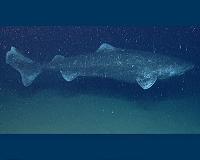
Greenland sharks are the Earth's longest-lived vertebrates — or creatures with a spine — with a lifespan that can last as long as 400 years, international researchers said Thursday.
Their slow growth rate — about one centimeter per year — contributes to their exceptionally long lives, beating out other well-known centenarians of the animal world such as the bowhead whale and the Galapagos tortoise.
In fact, only one species of clam is known to live longer, said the study in the journal Science, adding, "The life expectancy of the Greenland shark is exceeded only by that of the ocean quahog (Arctica islandica, 507 years)."
Known formally as Somniosus microcephalus, the Greenland sharks are the largest fish native to Arctic waters.
They also take a very long time to reach sexual maturity — about 150 years, said the report.
The study relied on radiocarbon dating techniques, applied to the eye lenses of 28 females caught unintentionally by fishermen seeking other species.
Researchers can learn about the age of marine creatures by finding traces of atomic radiation in their tissues, resulting from atmospheric tests of thermonuclear weapons since the mid-1950s.
They found that the two largest sharks in this study, at 493 cm (16 feet) and 502 cm (16.5 feet) in length, "were estimated to be roughly 335 and 392 years old, respectively."
The Greenland sharks' average lifespan is believed to be about 272 years, said the study led by researchers at the University of Copenhagen.
Co-authors came from the Greenland Institute of Natural Resources, the National Aquarium Denmark, the Arctic University of Norway, Indiana University-South Bend, the University of Oxford, and the Virginia Institute of Marine Science.
Study: Marine animals live longer at high latitudes
Syracuse, N.Y. (UPI) Aug 11 – Want to live longer? Live closer to the poles. At least that's the strategy employed by bivalves like oysters, clams, scallops and mussels.
In a recent study published in Proceedings of the Royal Society B, researchers revealed bivalves living closer to the North and South pole grow slower and live longer than their peers closer to the tropics.
"We've created a global database of more than 1,100 populations of marine bivalves, documenting their maximum reported lifespan and growth rate, along with body size," David Moss, an Earth scientist at Syracuse University, said in a news release.
"Cold-blooded marine animals, such as bivalves, are influenced by their environment, so latitudinal patterns that exist in bivalves likely exist in other invertebrates, too."
Scientists believe polar ecosystems look and behave similar to ancient ecosystems, which suggests Earth's earliest creatures also opted for a slow-growth strategy.
Linda Ivany, fellow researcher and Syracuse professor, thinks the findings set scientists on a course for explaining the changes in size and metabolism measured among modern marine animals.
"Research shows that marine animals have gotten bigger over the last 500 million years," Ivany explained. "Because body size is determined by how fast you grow and how long you grow, this work sets the stage for us to move back in time and answer evolutionary questions about why and how animals have gotten bigger."
In addition to further exploring the link between growth and size over the last 540 million years, Ivany and Moss also hope to explain the correlation between growth strategy and speciation. Biodiversity is greater closer to the tropics than the poles.
"Short generation times and high mutation rates associated with short lifespan and fast growth enable new species to appear at a faster rate in the tropics," Moss added.
"The distribution of lifespan and growth with latitude might help explain one of the more fundamental patterns in the evolutionary and ecological history of animal life on the planet: the latitudinal diversity gradient."
