
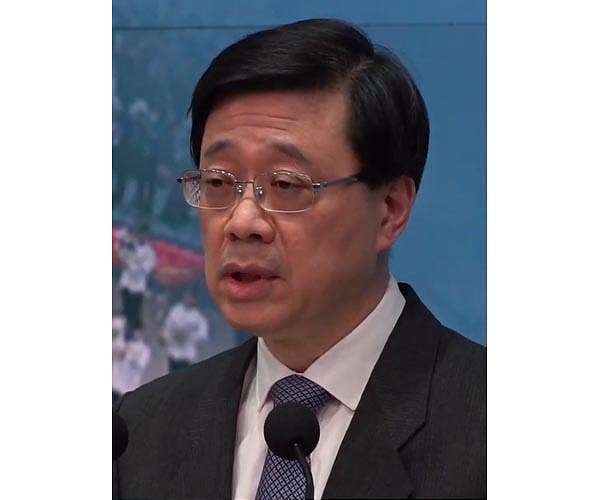
G7 foreign ministers on Monday voiced misgivings about how Hong Kong's new leader was chosen, accusing the Chinese territory of flouting democratic convention.
Canada, France, Germany, Italy, Japan, the UK and the United States joined the EU in putting on record their "grave concern over the selection process", in which a coterie of Beijing loyalists appointed John Lee.
Lee, 64, is a former security chief who oversaw the crackdown on Hong Kong's democracy movement and was the only candidate to succeed outgoing leader Carrie Lam.
The G7 foreign ministers said the selection process by secret ballot was "part of a continued assault on political pluralism and fundamental freedoms".
They accused the Hong Kong authorities and China of boosting the number of non-elected members to the election committee and "drastically" cutting eligible voters from the process.
"The current nomination process and resulting appointment are a stark departure from the aim of universal suffrage and further erode the ability of Hong Kongers to be legitimately represented," they added.
"We are deeply concerned about this steady erosion of political and civil rights and Hong Kong's autonomy."
US Secretary of State Antony Blinken, in a tweet on the joint statement, said that Beijing "undermined" Hong Kong's "ultimate aim of universal suffrage in the undemocratic selection of the Hong Kong Chief Executive".
EU foreign policy chief Josep Borrell on Sunday said the result was "yet another step in the dismantling of the 'one country, two systems' principle", where Beijing promised it would maintain key freedoms and autonomy.
The G7 foreign ministers repeated their calls for China to uphold its bilateral and international legal commitments in the former British colony.
They also urged Lee to "respect protected rights and freedoms in Hong Kong, as provided for in the Basic Law, and ensure the court system upholds the rule of law".
Western multinationals congratulate Hong Kong's new leader
Hong Kong (AFP) May 9, 2022 – Western multinationals and local tycoons published newspaper adverts on Monday congratulating John Lee on becoming Hong Kong's next leader, following a rubber-stamp selection process condemned by critics as anti-democratic.
Lee, 64, a former security chief who oversaw the crackdown on Hong Kong's democracy movement, was anointed the business hub's new leader on Sunday in a near unanimous vote by a small committee of Beijing loyalists.
He was the sole candidate in the Beijing-backed race to succeed outgoing leader Carrie Lam at a time when Hong Kong is being remoulded in China's authoritarian image.
Ta Kung Pao and Wen Wei Po, two newspapers that answer to the office which sets Beijing's Hong Kong policy, were filled with adverts on Monday from leading companies and business figures praising Lee's selection.
The majority were from Chinese and Hong Kong businesses as well as community organisations.
The "Big Four" accountancy firms — KPMG, Deloitte, EY and PwC — were among western multinationals placing adverts, as were city carrier Cathay Pacific and conglomerates Swire and Jardine Matheson.
Messages were also carried by Hong Kong's family tycoon-dominated property giants including Sun Hung Kai and Henderson Land Development.
Western businesses have found themselves in an increasingly precarious position in Hong Kong, especially as geopolitical tensions have risen with China.
Many have embraced progressive political causes in western markets, such as the anti-racism Black Lives Matter movement, same sex equality and ridding supply chains of labour abuses.
But they usually steer clear of any criticism of China's policies towards hotspots like Hong Kong, Xinjiang, Tibet and Taiwan.
Some companies such as HSBC, Standard Chartered, Swire and Jardine Matheson publicly backed Beijing's national security law, which was imposed on Hong Kong after 2019's democracy protests to curb dissent.
Despite the city's mini-constitution promising universal suffrage, Hong Kong has never been a democracy, the source of years of protests since the 1997 handover to China.
After the 2019 rallies Beijing responded with a crackdown and a new "patriots only" political vetting system that eradicated the city's once outspoken political opposition.
Lee faced no rivals and won 99 percent of the votes cast by the 1,461-strong committee that picks the city's leader — roughly 0.02 percent of the city's population.
Beijing hailed the process as "a real demonstration of democratic spirit".
European Union's foreign policy chief Josep Borrell countered that the selection process was a "violation of democratic principles and political pluralism".
