
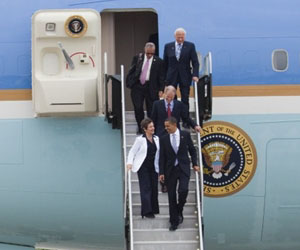
The anniversary of Hurricane Katrina, the withdrawal from Iraq, Mideast peace talks, and a shaky economy two months before mid-term elections: President Barack Obama's returns from vacation to a full plate of problems.
After ten days in Martha's Vineyard, playing golf and Scrabble and relaxing with his family, Obama steps back on the fast track Sunday, flying straight to New Orleans without even a stopover in Washington.
Eighty percent submerged when Hurricane Katrina struck five years ago, the city still has not come back from the deluge that overwhelmed its dikes and left more than 1,500 people dead.
"It's recovering, but there's some more work to do," said White House spokesman Bill Burton of the city, whose population is only 80 percent what it was before the Category 5 storm.
During his visit to mark the anniversary, Obama "will commemorate the lives lost and the shared sacrifice that the Gulf Coast experienced because of Katrina," the White House said.
The president also will pledge to "recommit the nation" to a region that more recently has struggled with the worst accidental oil spill in the history of the oil industry.
After New Orleans, Obama will turn to another legacy of his predecessor George W. Bush: Iraq.
After meeting with US troops at an army base in Texas, Obama will speak from the Oval Office Tuesday night to highlight the end of combat operations in Iraq, as promised.
Seven years after the US-led invasion, the number of US troops in the country has dropped below 50,000 for the first time.
But the United States is still tallying the costs of Iraq — 4,417 US dead and more than 700 billion dollars spent — and keeping its fingers crossed that it can pull out its remaining troops on schedule by the end of next year.
The White House has given assurances that the Iraqis are capable of assuming responsibility for their own security, a point Obama was expected to re-emphasize in his televised remarks to the nation.
But he risks being disproven by events: the country is regularly shaken by deadly attacks attributed to Al-Qaeda and Iraq's military chief has warned it would take nine more years before his forces are up to the job.
Without a doubt, though, the biggest challenge awaiting Obama comes Wednesday when he receives Israeli Prime Minister Benjamin Netanyahu and the president of the Palestinian Authority Mahmoud Abbas as they embark on direct negotiations for a Middle East peace.
The White House insists the talks, with their ambitious one-year timetable, can succeed. But the fact that it has taken 18 months just to get the deeply divided parties to the table, gives little ground for optimism.
Giving foreign policy such a high profile holds another risk for Obama: Americans might see him as uninterested in their problems at a time of high unemployment and new signs of weakness in the economy.
With Democratic majorities at stake in both houses of Congress in the November elections, the president's opponents have attacked what the Republican leader in the House, John Boehner, calls Obama's "job-killing agenda."
Aware of the vulnerability, the White House revealed that Obama had taken part Wednesday in a teleconference from Martha's Vineyard with this economic team. Burton also said the president would speak soon to Americans about the economy.
Share This Article With Planet Earth
