
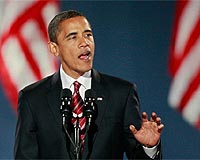
It will not cool the globe, but the new world climate accord may temper Washington's political heat for Barack Obama and it has crucially given him a deal he can defend at home.
The US president engineered the compromise with rising powers China, Brazil, South Africa and India, at the tense UN climate summit in Copenhagen.
"For the first time in history all major economies have come together to accept their responsibility to take action to confront the threat of climate change," Obama said, putting the best possible spin on an agreement that many said fell short of the summit goals and what science demands to stem global warming.
An obvious flaw: the pact is not legally binding, and while it commits to limit warming to two degrees Celsius (3.6 Fahrenheit) it fails to set targets for greenhouse gas emissions cuts.
But that very omission may make the accord palatable in Washington, where climate change scepticism is rising and critics warn Obama's energy revolution could squelch frail economic growth.
Obama came to Denmark under pressure to make concessions to Europe and developing states — but stuck by his offer to only cut US greenhouse gas emissions by 17 percent from 2005 levels by 2020.
He also dodged saying how much the United States would pay as part of a deal to help developing states tackle warming.
Holding that line may help preserve fragile support for a deal in the US Senate.
Copenhagen was another lesson for Obama in the application, and limits of US power.
He has smashed records for travel by a first-year president, but Obama has few foreign policy triumphs. Iran has spurned his hand of engagement, the Afghan war got worse, and his Middle East peace drive is stalled.
Domestic foes brand him a soft touch on the world stage and mock his failure in Copenhagen to win the 2016 Olympics for Chicago.
So going home empty-handed would have been another devastating blow, and Obama's dwindling approval ratings may benefit from accounts painting him as a diplomatic maestro behind the accord.
Some observers sought however to dampen the idea that it had been Obama alone who salvaged the conference.
"It was not driven by one leader, or two leaders, or three leaders," said Robert Orr, the UN's assistant secretary general for policy planning.
"I would have to count on two hands the number of leaders who played a really instrumental role."
In many ways, Obama's performance in Copenhagen revealed an emerging theme of his administration, which aimed at transformational change, but is now revealing a strong streak of pragmatic realism.
His "change" mantra has been diluted by reality on US health care reform, Middle East peace making, the Afghan troop surge and now climate change.
In each case, Obama scaled back lofty aims or qualified his ambitions, reasoning that politics is after all, the art of the possible.
This sparked cries of betrayal from some supporters intoxicated by candidate Obama's pure political potential and soaring rhetoric: though they do not face President Obama's obligation to fashion results from high expectations.
Obama reflected on his learning curve before flying home.
"One of the things that I've felt very strongly about during the course of this year is that hard stuff requires not paralysis but it requires going ahead and making the best of the situation that you're in at this point, and then continually trying to improve and make progress from there."
The accord is also grist for Obama's argument that his commitment to engagement has revived US prestige abroad an in international organisations.
Obama's allies rallied round to maximize the political payoff, as some of his top priorities face a rough ride in Congress.
Senate Majority leader Harry Reid praised Obama's "leadership" while House of Representatives speaker Nancy Pelosi added: "The president has secured a critical agreement."
Then there is the China question.
In his first year in office, Obama has painstakingly engaged Beijing and aides say he has formed a connection with Premier Wen Jiabao, who compered Copenhagen's operation.
But is his stock in Beijing sufficient to limit damage by his stern rebuke of Beijing's reluctance to embrace verification methods to check its compliance to climate pledges?
Share This Article With Planet Earth
