
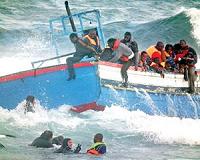
NATO now has five ships taking part in an unprecedented naval mission in the Aegean Sea to tackle people smugglers taking migrants from Turkey to Greece, the alliance's chief Jens Stoltenberg said Thursday.
Speaking at a news conference in Brussels with European Commission President Jean-Claude Juncker, Stoltenberg said NATO was pushing ahead with the deployment since it was approved last month.
"There are now five ships in the area, there will be more ships in the coming days, and we also have helicopters on most of the ships, so we are increasing the presence of NATO vessels with modern equipment," Stoltenberg said.
Stoltenberg said that at the weekend NATO expanded into Turkish and Greek territorial waters, a move that was delayed because of disagreements with Ankara.
The vessels were concentrating on the area around the island of Lesbos and aimed to "cut the lines of the illegal networks and illegal trafficking of people across the Aegean Sea."
Britain announced on Monday, ahead of an EU summit with Turkey on the migration crisis, that it was sending an amphibious landing ship and several other vessels to join ships from Canada, Germany, Greece and Turkey.
NATO launched the deployment, the first civilian operation of its kind for the military alliance, after a request by Greece, Turkey and Germany to help tackle Europe's biggest migration crisis since World War II.
More than one million people have crossed the Mediterranean since the start of 2015 including many refugees fleeing the war in Syria.
Macedonia eyes joining NATO in wake of migrant crisis
Ljubljana (AFP) March 10, 2016 –
Macedonia Defence Minister Zoran Jolevski on Thursday said he hoped his country's "responsible" attitude to the migrant crisis would help accelerate its entry into NATO, something Greece has blocked until now.
Jolevski said Macedonia, which has closed its border with Greece stranding thousands of migrants, had shown that it was a "responsible member of the international community".
More than 14,000 mainly Syrian and Iraqi refugees have been camped out on the Greece-Macedonia border crossing — many of them for weeks — at a squalid camp. Macedonia has not let anyone enter since Monday.
"This migrant crisis is yet more proof that all countries from the region must be integrated in NATO structures if their people and their politicians and governments wish it," Defence Minister Zoran Jolevski said in Slovenia.
"We believe that with more NATO members in the region, the region will be more stable," he said, adding that the country was pressing ahead with reforms of its military to comply with NATO standards.
Macedonia has been in a decade-long stalemate in the process of accession to both the European Union and NATO due to a veto by Greece. Athens denies its neighbour the use of the name Macedonia, claiming to have a historical right on it.
Macedonia in recent months allowed hundreds of thousands of migrants in from Greece to travel northwards through the western Balkans to northern Europe, but has now severely restricted access under pressure from Austria and other Balkan countries.
