
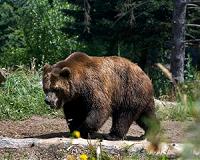
The first brown bear sighting in Portugal in more than a century was confirmed by wildlife experts on Thursday, after reports of an animal in the northeast of the country.
The bear, which most likely belongs to a population living in the western Cantabrian Mountains in northern Spain, is thought to have wandered across the border.
"The reappearance of individuals from this species in Portugal… has now been confirmed by the ICNF," the Portuguese Institute for Conservation of Nature and Forests (ICNF) said.
Brown bears have been extinct in Portugal since the 19th century.
"The last reports of a stable presence of brown bears in Portugal are between the 18th and the end of the 19th century. They then died out," the ICNF said.
The animal was spotted in the Montesinho Natural Park and Braganca commune in northeastern Portugal.
The town of Bragance is about 20 kilometres (12 miles) from the Spanish border.
Media reports say the last living bear in Portugal was killed in 1843 in the northwest mountainous region of Geres.
"The fact that a bear has crossed our border does not mean that there is a bear established in Portugal. At the moment we have a stray animal," said Paulo Caetano, an author of a book on bears, on Portuguese radio.
The animal is probably a young male looking for "a peaceful territory, a companion and food," he said.
The bear population in the Cantabrian mountain range, which extends east to west over four Spanish regions, has been increasing since the 1989 adoption of a relocation plan.
In 2018, some 330 bears were counted in the mountains there, according to the environmentalist foundation Oso Pardo.
Evolution brought rare flightless bird species back from the dead
Washington (UPI) May 9, 2019 –
Evolution produced the same flightless bird species twice, with each occurrence separated by tens of thousands of years. The phenomena, called iterative evolution, helped bring the flightless rail species back from the dead.
According to a new study, the bird twice settled on an isolated atoll near the Seychelles called Aldabra, losing its ability to fly after a several thousand years on the island. After climate change and rising seas in the Indian Ocean wiped out the original colonizers, the bird returned several thousand years later — after the seas subsided — and once again became flightless.
Both bird species evolved from the same ancestor, the white-throated rail, a chicken-sized bird native to Madagascar. Paleontologists analyzed rail fossils from deposits from before and after the atoll was inundated by rising seas. Their analysis revealed changes to the wing and ankle bones linked with the adoption of a flightless existence.
Because Aldabra is without terrestrial predators, the rail was able to quickly forego flight without putting itself at risk. The flightless rail species is still living on Aldabra today.
"These unique fossils provide irrefutable evidence that a member of the rail family colonized the atoll, most likely from Madagascar, and became flightless independently on each occasion," Julian Hume, an avian paleontologist at the Natural History Museum in London, said in a news release. "Fossil evidence presented here is unique for rails, and epitomizes the ability of these birds to successfully colonize isolated islands and evolve flightlessness on multiple occasions."
Hume and his colleagues published their analysis of rail's iterative evolution this week in the Zoological Journal of the Linnean Society.
"We know of no other example in rails, or of birds in general, that demonstrates this phenomenon so evidently," said David Martill, an environmental scientist at the University of Portsmouth. "Only on Aldabra, which has the oldest palaeontological record of any oceanic island within the Indian Ocean region, is fossil evidence available that demonstrates the effects of changing sea levels on extinction and recolonization events."
