
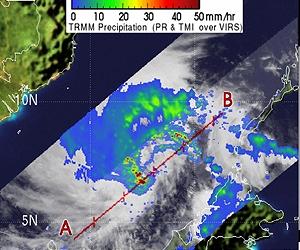
Tropical Depression 01W formed in the Northwestern Pacific Ocean yesterday and is now headed for a landfall in Vietnam. NASA satellite data shows that the system is weakening as it continues on its track through the South China Sea.
The Tropical Rainfall Measuring Mission (TRMM) satellite, managed by NASA and the Japanese Space Agency flew over Tropical Depression 01W (TD01W) on Monday, January 18 at 0859 UTC (3:59 a.m. ET/ 3:59 p.m. local time, Vietnam).
TRMM noticed that the storm's rain fall was limited to the northern and western sectors of the storm. There were some isolated areas of heavy rainfall where rain was falling at about 2 inches per hour. However, most of the rain was moderate, falling at rates between 20 and 40 millimeters (.78 to 1.57 inches) per hour.
TRMM images are pretty complicated to create. They're made at NASA's Goddard Space Flight Center in Greenbelt, Md. At Goddard, rain rates in the center of the swath (the satellite's orbit path over the storm) are created from the TRMM Precipitation Radar (PR) instrument.
The TRMM PR is the only space borne radar of its kind. The rain rates in the outer portion of the storm are created from a different instrument on the satellite, called the TRMM Microwave Imager (TMI). The rain rates are then overlaid on infrared (IR) data from the TRMM Visible Infrared Scanner (VIRS).
At 10 a.m. ET (10 p.m. Vietnam local time), January 19, Tropical Depression 01W had maximum sustained winds near 25 knots (28 mph).
It was located about 190 miles southeast of Ho Chi Minh, Vietnam, near 9.1 North latitude and 108.7 East longitude. TD01W was moving northwest near 8 knots (9 mph). TD01W is generating 8- foot high waves in the South China Sea.
Satellite data has also shown that TD01W's low level circulation center is exposed, and that the storm is in an area with vertical wind shear (which can weaken and tear a storm apart). An exposed center allows dry air or wind shear to enter the storm and weaken it. TD01W is forecast to weaken over the next 12 hours and dissipate after making landfall in Vietnam.
Share This Article With Planet Earth
