
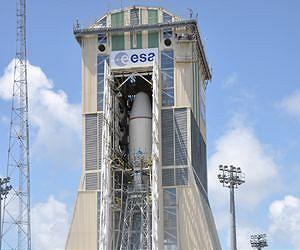
Preparations for the simulated first flight of Soyuz from French Guiana are proceeding on schedule for a "liftoff" this week, confirming the medium-lift vehicle's readiness to join Arianespace's launcher family during 2011.
With a fully-assembled Soyuz now on the Spaceport's launch pad for its historic dry run exercise, mission teams have entered the final phase of preparations – providing a realistic validation of operational procedures from the vehicle's rollout to the "virtual" liftoff and downrange mission trajectory.
Bruno Gerard, Arianespace's project head for Soyuz at the Spaceport, said the dry run mission campaign is progressing well, confirming that the extensive amount of advance work has brought this launch system to a highly mature status for its introduction at French Guiana.
The dry run began on Friday, April 29 with a morning transfer of the three-stage Soyuz from its assembly facility to the massive purpose-built concrete launch pad in the Spaceport's north zone. The vehicle then was erected and covered by the protective service gantry in the afternoon hours, followed by integration of the upper composite (consisting of Soyuz' Fregat upper stage and payload fairing) during the nighttime hours.
"We performed the complete launcher transfer, erection and upper composite integration process during the dry run's first day, demonstrating that our efforts have paid off well in preparing Soyuz for its service entry with Arianespace," Gerard explained. "As everything is moving ahead very smoothly so far, most of the issues we are dealing are minor – which is a real tribute to everyone involved in bringing Soyuz to French Guiana."
The dry run is replicating a typical five-day final preparation phase for Soyuz at the Spaceport, except for actual fueling of the launch vehicle.
Activity during the campaign's initial day (referred to as "J -4" in the French-language mission terminology) on Friday involved Soyuz' horizontal rollout from the assembly building, its erection on the launch pad and integration of the upper composite.
After successful achievement of the work on J -4, the Saturday action for J -3 focused on Soyuz' launch rehearsal, as well as telemetry tests with the Spaceport's receiver and tracking network. Sunday was a programmed day off in the dry run exercise for the involved teams.
Today's work during J -2 continues the launcher's tests and checkout, as well as additional base and telemetry testing.
J -1 activity tomorrow will involve the launch readiness review milestone, followed by deployment of some of the various fueling vehicles to Soyuz' launch pad. During an actual mission, liquid oxygen and kerosene propellants will be loaded in launcher's first-stage strap-on boosters, its Block A core second stage and the Block I third stage; while liquid nitrogen will be used for onboard pressurization and inerting; and hydrogen peroxide is supplied to drive gas turbines that power Soyuz' turbopumps.
For the dry run's launch day (J 0) on May 4, the final countdown will be performed, including the mobile service tower's 80-meter rollback from the launch pad to its parking position at 1 hr. 30 min. before scheduled liftoff – revealing a completely-assembled Soyuz for the first time. The countdown then will be purposely stopped, allowing a validation of procedures in the scenario of a launch-day interruption.
A resumption of the final countdown will occur May 5, continuing through the simulated liftoff and downrange mission trajectory.
The dry run will wrap-up with a simulated draining of fuel from Soyuz on the launch pad, followed by removal of its upper composite, and concluding with the vehicle's horizontal return to the Spaceport's assembly building.
Arianespace is targeting the first two Soyuz launches from French Guiana this year, beginning with a mission to orbit a pair of Galileo IOV (In-Orbit Validation) navigation satellites for Europe.
Share This Article With Planet Earth
