
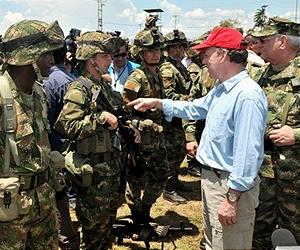
Clashes between Colombian soldiers and leftist guerillas continued Friday in a jungle zone where the insurgency's top military leader was killed in airstrikes.
The body of Jorge Briceno Suarez, the feared commander of the Revolutionary Armed Forces of Colombia (FARC) known as "Mono Jojoy," was found Thursday in a jungle camp that Defense Minister Rodrigo Rivera described as "the mother of all bases of the FARC."
Forensic experts positively identified his remains on Friday by matching his fingerprints with information on file.
But fighting continued around the camp, located in a rugged part of the Macarena region in central Colombia, with some 20 other rebels killed and 13 soldiers wounded so far.
"That shows the intensity of the fighting," Rivera said.
Military operation leader General Miguel Perez said Colombian troops were facing resistance as they advanced.
"I cannot give details, but we are continuing the operations and looking for guerrillas to surrender. We are expecting demobilizations in the next days," he said, noting that the fighting is taking place in "a rugged area of very difficult access."
Rebels killed in the attack included three senior rebel leaders — a member of the FARC directorate, a regional military commander and the head of the group's urban militias — according to the military.
The Defense Ministry has released pictures of Briceno that appeared to show him wrapped in bloody camouflaged material. The man's bruised and swollen face lacked his famous mustache.
Forensic experts were struggling to identify at least seven other bodies because they were rapidly decomposing, a senior medical official said.
Fearing that Briceno's death could unleash a new wave of violence, more than 2,000 police officers have been deployed to protect key areas of Bogota, officials said.
Speaking in New York on the sidelines of the United Nations General Assembly, US President Barack Obama praised the "outstanding work" of Colombia's military, which receives strong US support.
Thursday "was a big day for the people of Colombia and those who are seeking peace in the region," Obama told President Juan Manuel Santos during their first meeting since Santos took office on August 7.
On the heels of its advances on the guerrillas, Santos pointed to a "new era" for Colombia.
"Now that the security problem is more or less solved, we can now turn to a more progressive agenda," he told Obama. "Social development, the prosperity of our people, climate change, the environment — those are the type of issues that we can now include in our agenda."
Venezuelan President Hugo Chavez, who had an adversarial relationship with Santos's predecessor Alvaro Uribe, said Colombia should find the road to peace now that Briceno was dead.
"You can't be happy at anybody's death," the firebrand leftist leader said in Caracas.
"While I don't pretend to interfere in Colombia's internal affairs, I hope it finds the path to a peace agreement" with FARC rebels, he added.
Chavez and Uribe had an ugly spat in which the former Colombian president accused Venezuela of harboring hundreds of FARC and other leftist rebels on its territory, a charge Chavez strongly denied.
The FARC is Colombia's oldest and largest leftist group, with an estimated 8,000 combatants. Another leftist guerrilla group, the National Liberation Army, has some 2,500 fighters.
Share This Article With Planet Earth
