
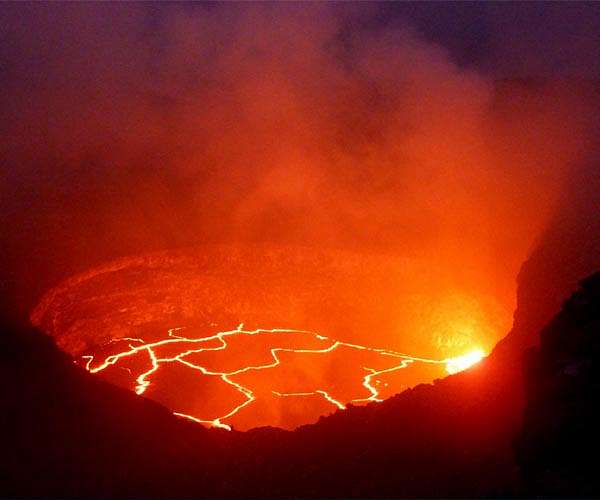
Scientists were able to estimate the viscosity of magma inside Hawaii's Kilauea Volcano by studying fault movements before and during the volcano's eruption in 2018.
The breakthrough, detailed Wednesday in the journal Nature, could help scientists forecast a volcano's eruption style.
Magma's viscosity is an important factor in determining the violence with which a volcano will erupt.
Thicker magma makes it more difficult for hot gas to rise and escape.
In magma chambers filled with more viscous molten rock, pressure is more likely to build up, increasing the risk of explosive eruptions.
Thinner, less viscous magma tends to erupt more gently, posing less risk to surrounding communities — or at least giving local populations more time to evacuate.
Unfortunately, relevant magma viscosity data is hard to come by.
"Magma viscosity is usually only quantified well after an eruption, not in advance," lead study author Diana Roman said in a press release.
"So, we are always trying to identify early indications of magma viscosity that could help forecast a volcano's eruption style," said Roman, a geophysicist and staff scientist at the Carnegie Institution for Science.
In collaboration with volcanologists and seismologists in Germany and Hawaii, Roman developed a new technique for estimating magma viscosity prior to a volcano's eruption.
By measuring fault movements, researchers mapped the pre-eruption stresses in the rock surrounding Kilauea.
The slow-going nature of the volcano's 2018 eruption, which began in May and lasted three months, allowed scientists time to study seismic changes as the magmatic unrest began.
Roman and her research partners used the seismic data collected in volcano's lower East Rift Zone to predict the presence and behavior of low and high viscosity magmas.
As fissures opened, researchers were able to test the accuracy of their predictions.
"We were able to show that with robust monitoring we can relate pressure and stress in a volcano's plumbing system to the underground movement of more viscous magma," Roman said.
"This will enable monitoring experts to better anticipate the eruption behavior of volcanoes like Kilauea and to tailor response strategies in advance," Roman said.
