
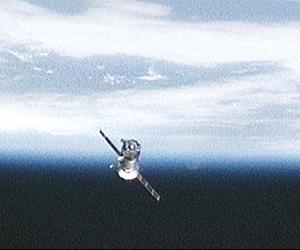
The Soyuz TMA-17 spacecraft carrying Expedition 23 Commander Oleg Kotov and Flight Engineers T.J. Creamer and Soichi Noguchi undocked at 8:04 p.m. EDT from the International Space Station's Zvezda module. The spacefarers will land on the steppes of Kazakhstan in a few hours time, wrapping up their stay in space.
The station now is occupied by Expedition 24 Commander Alexander Skvortsov and Flight Engineers Tracy Caldwell Dyson and Mikhail Kornienko. A new trio of Expedition 24 flight engineers – NASA astronauts Shannon Walker and Doug Wheelock and Russian cosmonaut Fyodor Yurchikin – will launch from the Baikonur Cosmodrome on June 16 aboard the Soyuz TMA-19.
After 163 days in space, 161 of those aboard the station, Commander Oleg Kotov and Flight Engineers T.J. Creamer and Soichi Noguchi boarded their Soyuz TMA-17 spacecraft today for the voyage home, closing the hatches at 4:54 p.m. EDT. With Kotov commanding the Soyuz, they will undock at 8:04 p.m. for a landing in the steppes of Kazakhstan at 11:24 p.m.
The departure of Kotov, Creamer and Noguchi marks the end of Expedition 23. Remaining aboard the station are Alexander Skvortsov, commander of the new Expedition 24 crew, and Flight Engineers Tracy Caldwell Dyson and Mikhail Kornienko.
Joining them in two weeks to complete the crew will be Flight Engineers Doug Wheelock, Fyodor Yurchikhin and Shannon Walker, scheduled to launch from the Baikonur Cosmodrome in Kazakhstan on June 15 aboard the Soyuz TMA-19 spacecraft.
Skvortsov assumed command of the station after a brief ceremony on Monday to allow Kotov to focus his attention on undocking preparations. Kotov spent much of the early part of his workday Tuesday packing equipment in the Soyuz, while Skvortsov, Kornienko and Creamer prepared experiment samples for return to Earth.
Meanwhile, Caldwell Dyson had time scheduled to collect samples from a Japanese experiment studying the decrease in the strength of the cell walls of rice seedlings in a weightless environment.
post newsletter distribution update
Astronauts land safely in Kazakhstan after mission
A Russian Soyuz spacecraft on Wednesday brought a Russian cosmonaut and US and Japanese astronauts safely back to Earth on the steppe of Kazakhstan after a five-and-a-half month stay in space.
Russian Oleg Kotov, Soichi Noguchi of Japan and US astronaut Timothy Creamer "landed southeast of Kazakhstan's town of Jezkazgan" as they returned from the International Space Station (ISS), said Russia's Mission Control outside Moscow.
Television pictures showed the capsule carrying the astronauts being guided by a parachute and producing a plume of dust as it touched down under clear blue skies.
The trio, still strapped to their seats and covered with blankets, were given apples — a traditional welcome-back gesture — as doctors and rescuers swarmed around to conduct regular checks and help adjust them to gravity.
Broadly smiling, the astronauts joined hands with each other and gave thumbs-up signs as they posed for cameras.
"A very good landing. Everyone feels excellent," the chief of Russia's space agency Anatoly Perminov told reporters.
"Recently, all the touchdowns have been not just successful but with a high-precision landing and most importantly, excellent health," he said televised remarks.
"You see they are already eating apples," he added, referring to television pictures showing Noguchi happily chewing an apple.
Kotov, the Soyuz commander, was at the controls of the spacecraft when it undocked from the station, NASA said. He will return to Russia's space training centre outside Moscow, while Creamer and Noguchi will go back to Houston, it said.
The trio left Earth in December for a mission to the ISS where they spent five and a half months.
During their stint at the ISS, they supported three space shuttle missions and "put finishing touches on US laboratory research facilities," among other duties, NASA said.
Russian cosmonauts Alexander Skvortsov and Mikhail Korniyenko and US astronaut Tracy Caldwell Dyson took over aboard the ISS.
A video posted on the NASA website showed the departing and remaining astronauts shaking hands and hugging each other amid banter and laughs.
"We will be thinking about you guys all day," Dyson said.
"Only one?" a Russian colleague shot back.
"Only one day and that's it," Dyson replied, laughing.
The ISS, which orbits 350 kilometres (220 miles) above Earth, is a sophisticated platform for scientific experiments, helping test the effects of long-term space travel on humans, a must for any trip to distant Mars.
Share This Article With Planet Earth
