
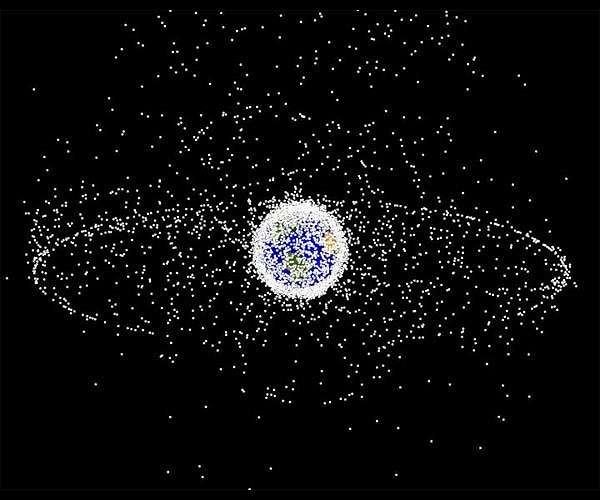
Many recent articles have expressed concern about the growing amount of junk floating around Earth in low orbits. Ultimately, the mass and distribution of junk and active satellites will exceed the capacity of space to safely contain the debris generated by the addition of more than an estimated 50,000 new satellites planned for deployment in the next few years. If and when this limit is reached our ability to travel in space may be greatly diminished.
When will this happen? No one knows the answer, but It could be soon. As the space capacity approaches its limit there will be a noticeable increase in disabled spacecraft due to debris collisions. This will likely be followed by a chain reaction that will involve freshly created debris being exponentially multiplied until major segments of near-Earth space are gridlocked with junk of all sizes. Such an event could take only days or weeks to entirely end access to space.
Can remedial action wait until this gridlocking event starts? Spacefaring nations have two options. Continuing business as usual could result in the total loss of space activities for decades, if not longer. One option that could make space activities sustainable is the immediate initiation of a space-based debris population control program that does three things:
+ Precisely tracks and projects the trajectories of all resident space objects (RSO) such that active satellites can avoid conjunction with large passive objects
+ Controls the population of small debris objects through active removal operations
+ Manages space traffic of active satellites to maintain safe flight paths
The "do nothing" option could result in the complete loss of the half-trillion-dollar annual space commerce revenue. The reopening of space would cost at least several hundred billion dollars and likely take decades to achieve. The second option would assure continued safe commerce but require a very complex program involving several new space systems and a multi-billion-dollar annual budget.
Unfortunately, the world economy cannot afford to do nothing. The real choice is to either pay for space sustainability now or pay much more later.
