
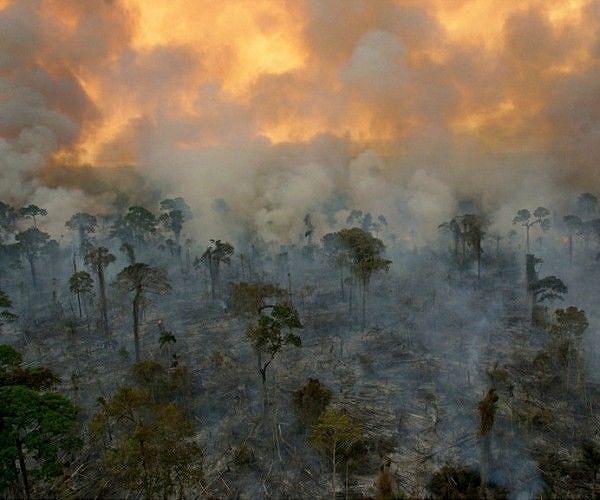
Forest fires that have raged for days in Colombia's Amazon on Saturday put its Andean capital, Bogota, on an environmental alert as bad air quality spanned an area the size of greater Paris, authorities said.
Wind carried smoke from several fires blamed on armed groups some 350 kilometers (220 miles) to the northwest, all the way to the Colombian capital.
Bogota Mayor Claudia Lopez said on Twitter that more than half of the capital's air quality monitoring stations have been off the charts for the past 48 hours.
"That is why, as an environmental protection measure" the city has issued an environmental alert, she wrote.
Lopez urged her city's eight million people to refrain from physical activities outdoors in the coming days.
Authorities have blamed the fires on former rebels who did not accept the 2016 peace deal with the government, saying that that they burn trees to raise cattle on the land.
In the central province of Guaviare, governor Haydeer Palacio, declared a "red alert" due to forest fires that have engulfed 10,000 hectares of land, an area similar to the total area of the French capital.
January of this year was the hottest month in the Colombian Amazon in a decade, also leading to an increase in forest fires in the southeastern region and very likely impacting air quality in the capital, according to an Environment Ministry report seen by AFP Friday.
Record heat, forest fires in Colombia's Amazon in January
Bogota (AFP) Feb 5, 2022 –
January of this year was the hottest month in the Colombian Amazon in a decade, leading to an increase in forest fires in the southeastern region and very likely impacting air quality in the capital Bogota, according to an Environment Ministry report seen by AFP Friday.
It said the month of January recorded the "highest hot spot values in the last 10 years" in the Colombian Amazon.
The phenomenon occurs, the ministry said, when the country goes through a season of low rainfall, and is due to human activity, of which "the most important is associated with deforestation fronts."
At least 80 percent of the "hot spots" were forest fires, a ministry spokesman told AFP. At the end of January, the ministry identified more than 3,300 "hot spots" in the six departments that make up the Colombian Amazon, including 1,300 in the Guaviare region alone.
According to testimony collected by AFP in October in the region, peasants and landowners take advantage of the dry season, from January to April, to burn or cut down trees and plant coca plants in their place, or to let cattle graze there.
The Serrania del Chiribiquete National Park, listed as a UNESCO World Heritage Site, is particularly threatened, as is the Nukak National Nature Reserve, a vast territory of jungle inhabited by the last nomadic indigenous people of Colombia.
The Foundation for Conservation and Sustainable Development (FCDS), which keeps its own count and regularly flies over the areas concerned, recorded at least 938 forest fires, the highest monthly January figure since 2012.
"Thousands of hectares of Amazon jungle, cut in recent months, are on fire today. These massive fires are now being felt as far away as Bogota," FCDS director Rodrigo Botero warned on Twitter.
"There are public health decisions to be made quickly. What are the air indicators saying in Bogota?"
Bogota mayor Claudia Lopez decried "the inability" of the government "to control the territory and guarantee security."
She described the fires as "arson attacks … which, due to the direction of the wind, end up arriving and deteriorating the quality of the air" in the capital, almost 500 km away.
In Medellin, the country's second most populous city, officials have warned of a deterioration in air quality to a level "harmful to the health" of children and the elderly.
According to data from the Colombian government, deforestation has exploded in recent years in the country's Amazonian regions, notably as a result of the historic peace deal signed in 2016 with the Marxist guerrillas of the FARC, which then abandoned large swaths of territory which they previously controlled.
