
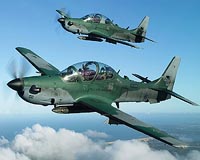
The first of 20 U.S.-built A-29 Super Tucano light attack and trainer aircraft has rolled off the assembly line in Florida for the U.S. Air Force.
The plane, built by Brazilian aircraft manufacturer Embraer and its U.S. partner Sierra Nevada Corp., was selected by the Air Force for its Light Air Support program for Afghanistan.
"The Light Air Support program is critical to the U.S. objectives in Afghanistan and to our national security," said SNC's Chief Executive Officer Fatih Ozmen. "SNC, as the prime contractor, is proudly serving our country through its strategic partnership with Embraer by providing a superior aircraft, exceptional training and expert support and maintenance for this U.S. Air Force program.
"We look forward to continuing to deliver on time and on budget this important capability for Afghanistan now and into the future to ensure both the successful withdrawal of U.S. troops and the safety and security of the entire region."
The Super Tucano is a light air support turboprop. It's used by nine countries to train pilots and perform air support for ground troops. Operational for more than 10 years, A-29s around the world have flown more than 230,000 flight hours and 31,000 combat hours.
The first Super Tucano for the U.S. program rolled off an assembly line in Jacksonville, Fla., which Embraer specifically opened for the USAF contract work.
More than 100 U.S. companies are involved with supplying components for the plane.
"This first aircraft delivery is a significant milestone for the A-29 program," said U.S. Air Force Brig. Gen. Eric Fick. "This delivery represents the birth of an important capability for Afghanistan, and we are very pleased Sierra Nevada Corporation and Embraer were able to deliver the aircraft on time to meet the start of Air Advisor Training at Moody Air Force Base."
SNC and Embraer were awarded the contract, worth more than $400 million, in February of last year to build the A-29s for the LAS program. Beechcraft Corp., which was offering its own plane, officially protested the Air Force decision.
"It is deeply distressing that the Air Force selected a more expensive, less capable, foreign-manufactured airplane with weapons and systems unfamiliar to, and outside the control of, the United States military," Beechcraft said in a news release. "We have known that the requirements for this procurement were written to favor the competition's aircraft.
"During this protest, we learned that the GAO's (Government Accountability Office) review looks only at whether the Air Force followed its process, but not whether the process itself was actually correct or appropriate."
Beechcraft's offering was its AT-6, a light air support and advanced trainer based on its T-6 Texan II aircraft, which the Air Force has used for pilot training.
