
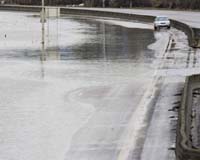
Hundreds of homes were flooded Thursday in eastern Canada, where the rising waters of the St. John River forced power cuts and the closure of most provincial government buildings, officials said.
In Fredericton, the capital of New Brunswick province, water levels reached 8.28 meters (27.1 feet), more than two meters above the flood stage and nearing a record 8.63 meters set in 1973.
Officials blamed torrential rains and a spring thaw in the north of the province of the largest snow pack in the region's history.
In Fredericton, water levels climbed more than one meter in the last 24 hours, forcing the closing of the legislature, city hall, courthouse and schools, as well as some 50 roads.
As a precaution, electricity for 390 homes was also shut off.
"Water levels in most areas continued to rise overnight," said Andy Morton, deputy director of New Brunswick's Emergency Measures Organization, but added that fortunately, they were not as high as expected.
He said water levels would continue to rise but should peak Thursday.
Northwest of the province, where the river marks the border between Canada and the US state of Maine, hundreds of American residents abandoned their homes in the Fort Kent area under a state of emergency declared late Tuesday.
"What I saw there yesterday was something that I've never ever seen before," Maine's governor John Baldacci told Canadian public broadcaster CBC.
"I saw homes moving down stream off of their foundations, 600 families and individuals had to be evacuated."
Almost 673 kilometers (418 miles) long, the St. John River's headwaters originate in northern Maine and it empties into the Bay of Fundy in the Atlantic Ocean.
