
While doctors generally agree that too much stress is bad for human health, others are busy putting a number on it. The result may be a breakthrough in helping people to change their lifestyles in order to live longer.
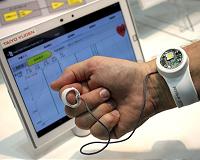
Engineers at Taiyo Yuden are busy developing a wearable device that measures the 'age' of the cardiovascular system. The wristwatch-like gadget analyzes the resilience of veins and arteries, then displays a chronological age reflecting that condition, showing the wearer how he or she stacks up against the average.
Taiyo Yuden showed off a prototype of its new Smart Pulse Analyzer at a recent medical tech expo in Tokyo. A wire stretched from the main body of the ceramic 13mm x 13mm unit to a gauze ring placed around the index finger. Pulse, blood pressure, and other detectable data were sent wirelessly for display to a computer monitor in real time.
A throng of interested onlookers – mostly older folk – lined up for a sample demonstration to see if they were actually 'younger' than their actual age. One 71-year-old man was pleased to find out that his arterial age was a more robust 55.
"Doctors and anesthesiologists have voiced concerns over the effect of the pain of surgery on stress levels and how that could translate into damage to the heart and blood vessels," said Takashi Ishiguro, Ph.D., head of the company's new business development division.
"Measuring such effects is an imperfect science. But high blood pressure is one of the most salient indicators of internal stress to the body. It has also been cited as a significant symptom of poor health, so we believe that measuring it is a good place to start."
After three years, the sensor remains at the R and D stage, and an app for mobile devices is also up and running. But the system still has kinks to be worked out. Mr. Ishiguro did not say when mass production is likely to begin.
The concept behind the gadget is nevertheless intriguing. Assigning an empirical number to human cardiovascular age poses a challenge, especially for a company without a track record of developing proper medical diagnostic equipment. Taiyo Yuden has a history mainly as an OEM maker of inductors, ceramics, and high quality CDs, DVDs and other recordable media.
The relationship between stress and high blood pressure are also not perfectly understood. Generally speaking, stress typically produces a surge of hormones which temporarily increase blood pressure by causing the heart to beat faster and blood vessels to narrow. But there's no proof that stress by itself causes long-term high blood pressure, according to the Mayo Clinic, a nonprofit medical research group.
"It may be that other behaviors linked to stress – such as overeating, drinking alcohol and poor sleeping habits – cause high blood pressure. However, short-term stress-related spikes in your blood pressure added up over time may put you at risk of developing long-term high blood pressure," note researchers on the clinic's website.
Broad efforts have been made to help people understand such risks. In 2014, the Joint British Societies for the prevention of Cardiovascular Disease developed its JBS3 Risk Calculator, a tool to help communicate the risk of cardiovascular disease (CVD) and the benefits of lifestyle/pharmacological interventions. The calculator bases its analysis on diet, exercise patterns, and a person's existing medical condition.
The World Heart Federation has an online Heart Age calculator, a questionnaire that yields an overall picture of a person's heart health, and a general indication of how lifestyle factors may affect it. But the test is not intended to be a substitute for professional medical advice.
At the moment, few sensors like the Smart Pulse Analyzer appear to exist in the consumer market.
"It's clear that we're thinking 'outside the box' in trying to assess cardio-age," says Mr. Ishiguro. "Making the technology work is not such a feat. For us, selling it will be the real trick."
