
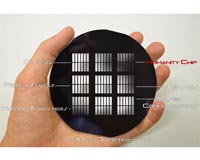
For the first time ever, individuals will have the opportunity to send their own personal message and/or data into space via microchip. The project entitled "Voices of Humanity" is the creation of the Santa Barbara-based team of UCSB Physics Professor Phil Lubin, Ph.D. and Travis Brashears, an engineering physics major at U.C. Berkeley.
Philip Lubin, a professor in physics at the University of California Santa Barbara, is the leading scientist on the endeavor. With his student Brashears who is working at the UCSB Physics Department this summer and went to San Marcos High School, they have launched a Kickstarter campaign called Voices of Humanity. They are inviting individuals to join them in a journey that will take their personal data to the stars via directed energy propulsion.
The purpose of the campaign is to collect data of the dreams, visions, images, movies, DNA, and literal voices of all of humanity, place them on a Humanity Chip, download them onto their wafer scale spacecraft, and then launch them in a series of increasingly sophisticated missions into outer space.
When the campaign raises $30,000, which is anticipated in July of 2016, the first launch will take place-shooting the data-loaded chips into earth's orbit. Subsequent launches will send data to increasingly farther targets, ultimately to the nearest star Alpha Centauri.
The $100,000 stretch-goal will be used to build a telescope (that the Lubin-Brashears duo will construct) and to purchase and design a laser encoder, which beams up the data. Ultimately, there will be two telescopes installed-the first in Santa Barbara and a second in Brazil or South Africa in the future.
Their Kickstarter campaign starts this journey by gathering their backer's data and launching it into orbit around Earth for the first milestone of their vision. "In this way your voice will literally live forever," stated Lubin. Costs for launching a participants data range from $1 for a "Tweet", $10 for a photo, $79 for DNA, and up to $1,000 for your own personal storage device to be beamed into space (limited to 100).
The physics duo developed the idea after another of their projects received lots of attention around the world, receiving over five million hits earlier this year on the announcement of their DEEP-IN project, a laser propelled, interstellar mission, a University of California Santa Barbara and the NASA Innovative Advanced Concepts (NIAC) funded project Phase I DEEP-IN and Phase II DEIS programs as well as the Breakthrough Starshot initiative.
"Our long-term goal is to enable the first interstellar missions and to eventually place the Voices of Humanity chips on those missions as emissaries of the Earth. It is a modern-day concept of a 'time capsule'," stated Brashears.
"Space access has changed dramatically with the entrance of the private sector. As companies such as SpaceX paving the way to lower cost access to low earth orbit (LEO) and with plans for Mars, we are quickly entering a new era. It is time to start thinking of going far beyond our solar system but doing so requires a radically new approach.
"We have done just that with our directed energy propulsion work at UC Santa Barbara with the goal of enabling the first interstellar missions using small wafer scale spacecraft to be sent to Alpha Centauri. We have ignited a passion from our NASA NIAC programs to the private sector Breakthrough Starshot effort," stated Lubin.
