
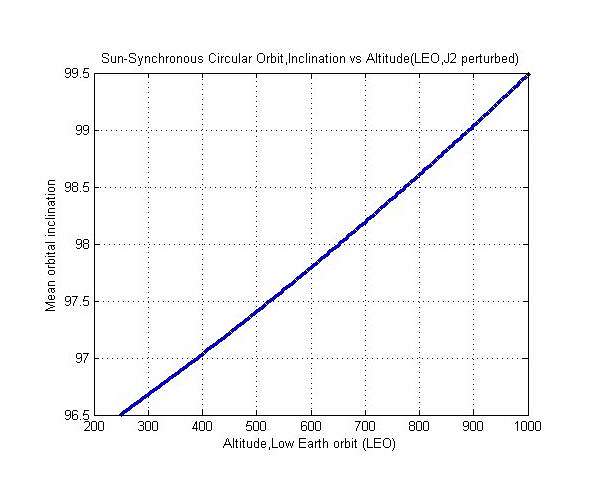
Sun-synchronous orbits are orbits that are ideal for earth observations in connection with civil and defense applications. Therefore, many satellites have been placed in such orbits.
Since these orbits have inclinations that require satellite to pass over north and south polar regions of the Earth during each circuit around the planet the probability of collisions with debris and other satellites is increased as compared to satellites in low-inclination orbits.
This increased danger has not been significant until recently. The explosive increase in low altitude constellation launches, however has changed the situation. Prior to 2010 there were only about 1200 active satellites in low orbits. Today, as many as 40,000 new satellites are planned and being launched at a high rate. Many of these will be in high-inclination orbits similar to those in sun-synchronous orbits.
The inclination of such orbits is critical because the density of objects in orbit varies with the latitude over which the object is flying. The least dense orbital zone is near the equator.
This density increases as the objects approach each polar region. As each orbiting object crosses a polar region the local density of objects increased dramatically. In fact, the occurrence of a collision between two objects has a much higher probability of happening new the polar regions.
A 40-fold increase in the population of objects in highly inclined orbits will lead to an extreme increase on conjunction in the polar regions. Of course, any collision will result in debris that circles the Earth and increases the entire debris population. Thus, a single collision happening in a polar region will increase the danger of more collisions all around the Earth.
The coming increase in collisions will undoubtedly look like a chain reaction that will eventually adversely affect all low-altitude constellations. Satellite operators have been able to ignore this eventuality because the number of satellites has been small.
Whether or not safe satellite operations will continue depends on the capacity of near-Earth space to accommodate 40,000 satellites plus an unknown number of debris objects.
