
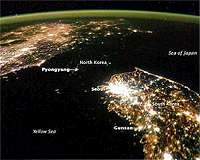
An editorial in North Korean newspaper Rodong Sinmun has responded to jibes the country has received over famous NASA satellite imagery showing a lack of nighttime lighting in the country.
A long editorial in Rodong Sinmun, the official organ of North Korea's ruling Workers' Party's Central Committee, has responded to NASA images that reveal what appears to be a dark space between brightly illuminated nighttime South Korea and China. It noted that while detractors "clap their hands…over a satellite picture of our cities without much light, the essence of society is not in its flashy lights."
The editorial called for the country to follow the leadership's calls to make new efforts to build up the country, while ominously noting that the US suffers from a multitude of problems of its own, including civil disturbances and crushing debt, and may face similar problems in the future. "An old superpower meeting its sunset may put up a face of arrogance, but it can't avoid its dark fate."
North Korea's leadership has recently stated that among its most pressing priorities is the restoration of electricity distribution. Leader Kim Jong-un's New Year's address featured exhortations to "meet the immediate demand for electricity" through "realistic measures to resolve the electricity problem," via economization, modernization, and the opening of new generation potential.
The country recently opened several power generating stations in the country's north, including Orangchon No.2, and has several hydroelectric projects in the pipeline.
Russian companies and officials have reportedly been in talks recently over an ambitious project to rebuild and modernize the country's dilapidated electricity grid in exchange for rare earth minerals contracts. At present, North Korea faces a massive deficit in power supplies and generating capacity, with its aging transmission infrastructure compounding the problem and resulting in the loss of up to 60-70 percent of the capacity that does exist.
North Korea suffered a near-complete collapse of its electricity distribution network in the early 1990s following the collapse of the Soviet Union, which provided the country with subsidized rates for the delivery of energy. The collapse resulted in the destruction of the economy, including its industry and agriculture, and the resulting famines have been estimated to have killed up to 220,000 people.
Source: Sputnik International
