
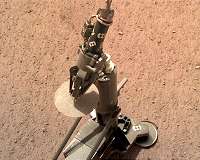
It stands vertically on flat ground, ready for its historic mission. At 19:18 CET on 12 February 2019, the German Aerospace Center Heat Flow and Physical Properties Package (HP3) or 'Mole' was deployed on the Martian surface using the NASA InSight mission's robotic arm. In the coming weeks, the remote-controlled penetrometer is expected to make space history by becoming the first probe to reach a depth of up to five meters in the Martian subsurface.
Its goal is to measure the temperature and thermal conductivity of the subsurface and thus determine the heat flow from the interior of Mars. The heat flow gives researchers indications about the thermal activity of the Red Planet. This can provide insights into the evolution of the Martian interior, whether it still has a hot liquid core, and what makes Earth so special in comparison.
"We are pleased that the deployment of our HP3 experiment onto the Martian surface went so smoothly," says Principal Investigator Tilman Spohn from the DLR Institute of Planetary Research in Berlin. HP3 is now in a stable position approximately 1.5 meters from the lander. "We hope that the Mole will not encounter any large rocks on its way into the subsurface," Spohn says.
The Seismic Experiment for Interior Structure (SEIS) was deployed previously – complete with an additional cover to protect it against wind and temperature fluctuations – at a similar distance from the InSight lander. SEIS and HP3 are approximately one meter apart.
Thermal Evolution of the Planets and Life on Earth
"From a thermophysical perspective, planets can be considered heat engines that generate volcanism, tectonics, and magnetism," explains Spohn. Heat flow measurements are important boundary conditions for modeling the thermal evolution of Earth, Mars and other planets.
While the seismometer and the observation of perturbations of the planet's rotation axis as part of the InSight Rotation and Interior Structure Experiment (RISE) shed light on Mars's interior structure, the measured heat flow constrains hypotheses about its evolution.
For the most part, scientists are convinced that a planet's geological evolution has great significance for its ability to host life and for the events that allow life to emerge at all. In the course of Earth's evolution, continents and oceans formed that are constantly subject to change and tectonic shifts.
The shallow continental seas or the chains of volcanoes in the oceans could be the places where life emerged. Mars lacks these tectonic elements, probably because it is smaller, and also because it does not have enough water to facilitate the process of plate tectonics – as happens on Earth – over a longer time period or permanently.
Mars had more water and ice in its early days than it does today and could have been hospitable to life, at least intermittently. With the help of InSight's measurements, researchers aim to gain a better understanding of the planetary-physical aspects of these complex interrelationships.
Into the Depths in Intervals
The Mole will pull a five-meter-long tether equipped with temperature sensors behind it into the Martian soil. After the target depth is reached, the tether's sensors will measure the temperature distribution at different depths and as it changes over time. In addition, the thermal infrared radiometer RAD on the InSight lander will measure the temperature of the Martian soil at the surface. Operational planning for the DLR instrument is currently underway.
