
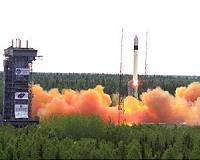
The director of the joint Kazakh-Russian enterprise JSC Baiterek said that the creation of a carrier rocket for the joint Russian-Kazakh Baiterek Space Complex at the Baikonur cosmodrome will approximately cost Russia $500 million, while the Kazakh side will finance the modernization of the existing facilities at the cosmodrome.
The creation of a carrier rocket for the joint Russian-Kazakh Baiterek Space Complex at the Baikonur cosmodrome will approximately cost Russia $500 million, while the Kazakh side will finance the modernization of the existing facilities at the cosmodrome, Oleg Balitsky, the director of the joint Kazakh-Russian enterprise JSC Baiterek, said.
"The roadmap to implement the project has been developed. According to these documents, the Russian side is responsible for development of a new promising carrier rocket, which approximately costs $500 million. The Kazakh side is responsible for modernization of the existing objects at the Baikonur cosmodrome, which will approximately cost $245 million. The project is now expected to be implemented by 2025," Balitsky said at a round table.
According to Balitsky, the preparation period is expected to complete in 2018, the research and development works, as well as financing of the project are expected to be carried out by 2023, and the tests are expected to take place in 2023-2025. The first launch of the carrier rocket is planned for 2025.
At the same time, Balitsky told Sputnik that the term of the implementation of the project may be accelerated.
In November 2016, Kazakh Deputy Prime Minister Bakytjan Sagintayev said the Baiterek Space Complex should be completed by 2021, but could be postponed due to the economic situation.
Russia and Kazakhstan have been implementing the Baiterek project since 2004. The project prescribes the construction of the infrastructure which will allow to launch environmentally friendly rocket carriers, instead of Proton rocket carriers, which use fuel with toxic components.
The Baikonur cosmodrome is an international facility in Kazakhstan for operating Russian and multinational space programs. Russia has leased the Baikonur space center until 2050.
Europe's largest sounding rocket launched from Esrange
MAXUS 9, Europe's largest sounding rocket for experiments in microgravity, successfully lifted off from SSC's (Swedish Space Corporation's) launch facility Esrange Space Center in northern Sweden.
The rocket was launched at 11:30 local time and carried nine scientific experiments and a technology demonstrator, all together 579 kg, to an altitude of 678 km which enabled slightly more than … read more
